Lumiera
Lumiera

Renovate to Stay

Turn your house into a dream home

Get your renovation estimate in under a minute

Improve your home and build value while you live in it

Aid schemes exist, we guide you through

Éco-PTZ, MaPrimeRénov’, energy premiums… Public schemes can finance part of your renovation. Lumiera guides you through the process, from eligibility to application.

Subsidised loan

Éco-PTZ

The zero-interest loan dedicated to energy renovation: we structure your quote so it meets the scheme’s criteria.

State grant

MaPrimeRénov’

The French state aid for energy renovation: we point you in the right direction and prepare the paperwork with you.

Stackable

Energy premiums & local aid

CEE premiums and local schemes, often stackable: we identify what applies to your home.

Each scheme has its own eligibility conditions, let’s review your project together.

Talk to an advisor

A clear journey,
up to the handover of the keys

Seven steps, zero fog: you always know what’s happening, and once the work starts, you’re updated every day.

  1. 1

    Visit

    First contact and assessment

    Us
    • Measurements and photos
    • Compliance checkpoints
    • Layout potential assessment
    You
    • Your wishes and needs
    • Your budget
    • Your timeline
  2. 2

    Intention

    The creative concept

    Us
    • Mood board
    • Creative direction tuned to your budget
    • First cost estimate
    You
    • Your feedback on the concept
  3. 3

    Design

    Detailed plans and 3D

    Us
    • Technical drawings
    • 3D model and projection images
    • Material & furniture sourcing (option)
    You
    • Your input when the deliverables land
  4. 4

    Quote

    Budget validation

    Us
    • Final adjustments
    • Line-by-line quote
    • Works schedule
    You
    • Signing off on the quote
  5. 5

    Construction

    Carrying out the work

    Us
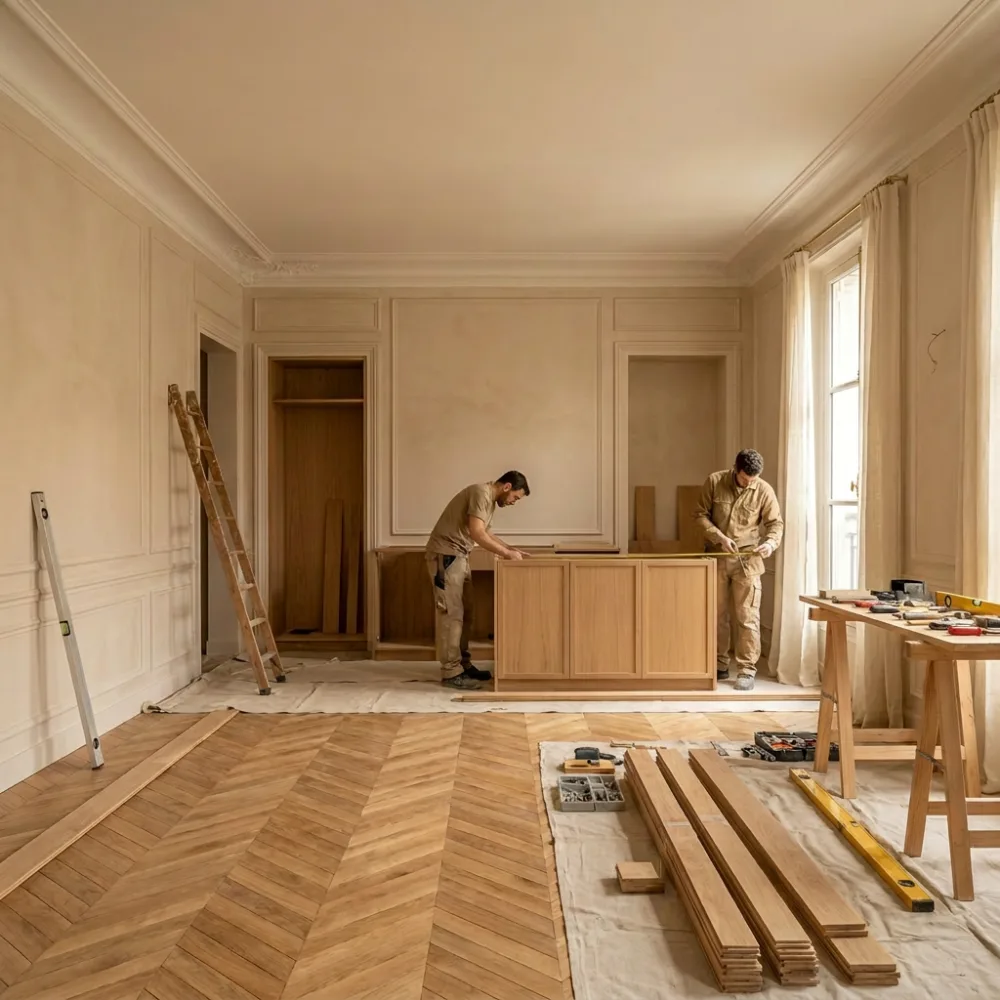
    • Kick-off with our in-house team
    • Continuous oversight
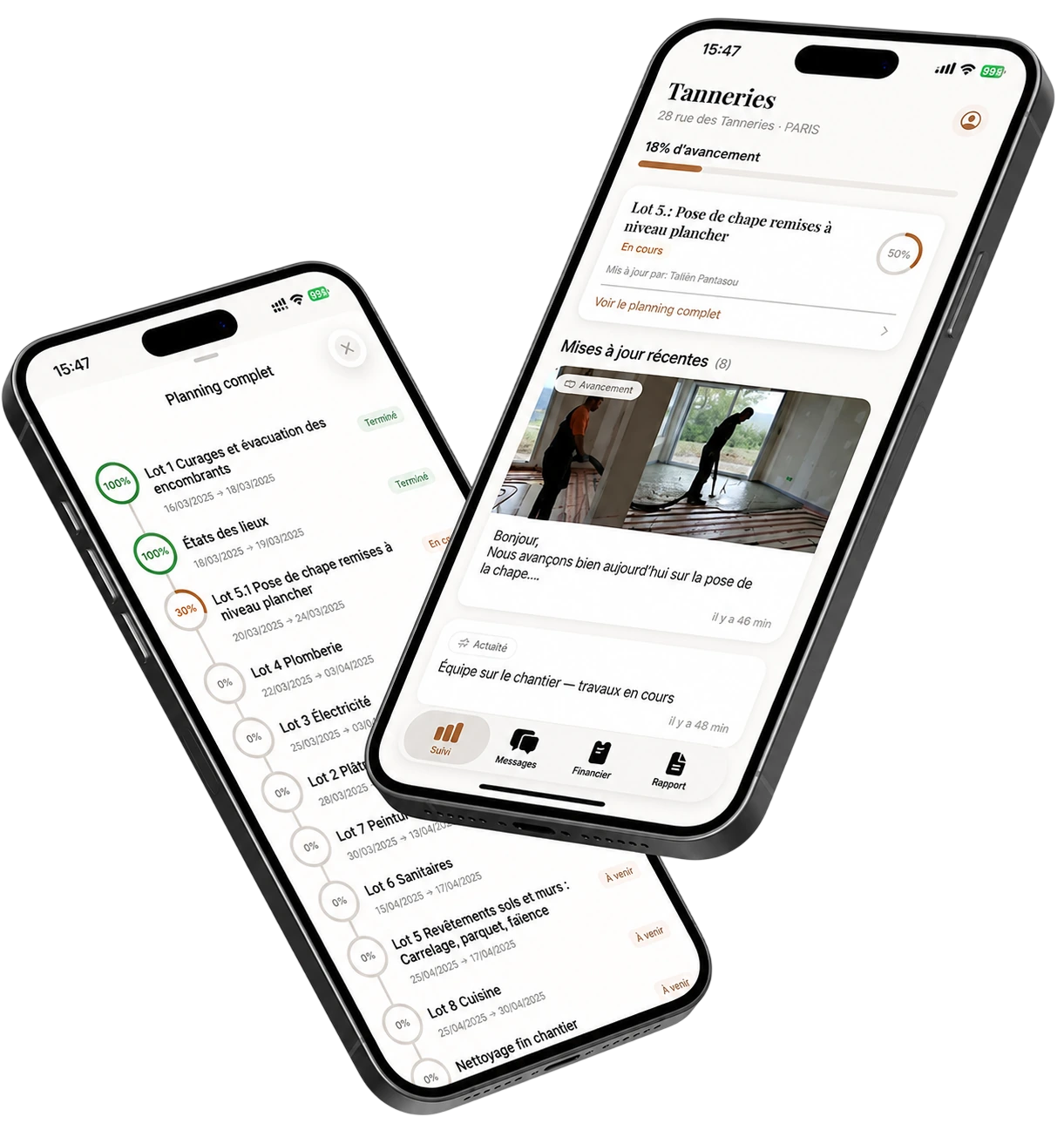
    • Daily updates in the app
    You
    • Follow everything, wherever you are
  6. 6

    Decoration

    Furniture and styling

    Optional
    Us
    • Furniture delivery and installation
    • A home ready to live in
    You
    • The final touches, together
  7. 7

    Handover

    Final delivery

    Us
    • Inspection visit
    • Finishing the last details
    • Handing over the keys
    You
    • Signing off on your project

With Lumiera, the choice is simple

One team that designs, prices and delivers your renovation.

Included Optional Not included
Service
Lumiera
General contractor
Works broker
Interior designer
Instant online estimate A first price range for your project in under a minute, with no appointment and no commitment.
Detailed line-by-line quote Every item is priced and explained, for a clear budget with no hidden costs.
Architecture and design in-house Rethinking the spaces and designing the decor, all by the same team, with no coordination left to you.
Responsibility for the works and guarantees We carry the responsibility and the guarantees for your renovation, up to the ten-year structural cover.
One dedicated contact One dedicated person pilots your entire project and stays your point of contact from start to finish.
Daily updates in the app Photos, progress and payments updated every day, so you are never left in silence during the works.

Frequently asked questions

What are the advantages of entrusting your renovation to a turnkey company?

Choosing a turnkey company means entrusting your entire project to a single partner, from the design stage through to the handover of the keys. You gain peace of mind and time.

  • A single point of responsibility: no more coordinating the architect, the tradespeople and the suppliers yourself, everything is managed for you.
  • A budget under control: a detailed quote, line by line, with no hidden costs or unpleasant surprises once the works begin.
  • Deadlines that are kept: a team that plans every trade avoids the idle gaps between contractors.
  • Consistent quality: the same standard from the first sketch to the finishing touches, with no dilution of responsibility.

At Lumiera, this promise rests on a simple principle: one point of contact and a salaried, in house team covering every trade, from the first sketch to the handover of the keys.

How much does a renovation cost in Paris, and what makes the budget vary?

The cost of a renovation depends above all on the scale of the works and the condition of the property. Every project is unique, but a few benchmarks help you get your bearings.

  • A refresh: paintwork, flooring and minor repairs often fall somewhere between 400 and 700 euros per square metre.
  • A full renovation: with the kitchen, bathroom and electrics redone, expect roughly 900 to 1,500 euros per square metre.
  • A high end renovation: fine materials, bespoke work and structural changes can exceed 2,000 euros per square metre.
  • The factors behind the variation: the initial condition, the plumbing and electrics to be redone, the co ownership constraints and the level of finish.

These ranges remain indicative, because your apartment, your wishes and your constraints are all your own. Only a detailed quote, drawn up after a visit, can price your project precisely.

How do you avoid going over budget?

Overruns usually come from a poorly scoped project or an incomplete quote. A few habits sharply reduce the risk.

  • Scope it upfront: define precisely what is included, and what is not.
  • Anticipate the state of the home: plumbing, electrics and structural fixes are the main source of surprises.
  • Insist on a clear quote: a line-by-line breakdown, with no vague items or loose contingencies.

At Lumiera the quote is detailed item by item and signed off before work starts, so you move forward with no surprises during the site.

How do you choose the right renovation company?

Choosing the right renovation company saves you months of stress and budget overruns. A few objective criteria help you decide with confidence.

  • The clarity of the quote: a good provider itemises every element, with no grey areas or vague wording.
  • The nature of the team: favour an integrated team over a cascade of subcontractors with diluted responsibilities.
  • Guarantees and insurance: check for the ten year structural guarantee, the guarantee of completion and the guarantee of proper working order.
  • Site monitoring: ask how you will be kept informed of progress, ideally in a regular and transparent way.

By reviewing these few points, you quickly tell a serious provider from a mere sales promise.

What types of work are covered by a turnkey renovation?

A turnkey renovation can range from a simple refresh to the complete transformation of a home. The advantage is bringing everything together under a single coordination.

  • Structural work: opening up walls, creating partitions and reworking the layout of the spaces.
  • The technical trades: plumbing, electrics, heating and ventilation brought up to standard.
  • Wet rooms and kitchens: bathrooms and kitchens designed and fitted to measure.
  • Finishes and fit out: paintwork, flooring, joinery, lighting and interior decoration.

Bringing all these trades together under a single coordination avoids the back and forth between contractors and clarifies responsibilities.

Which energy works are actually worth it?

Not all energy works have the same impact: it depends on the state of the home, how it is used and your priorities.

  • Insulation: often the best return on comfort and savings, starting with the weak points of the building.
  • Heating and ventilation: a well sized, properly tuned system weighs heavily on running costs.
  • Windows and doors: mostly worth it when the frames are old or draughty.

The key is to prioritise what genuinely works for your home, without spending on things that will not pay off.

Do you need permits to renovate (co ownership, load bearing walls, façade)?

Some works can be carried out freely, others require prior authorisation. Anticipating these steps avoids blockages and disputes once the works are under way.

  • The co ownership’s agreement: any work affecting the common areas or the exterior appearance generally requires a vote at the general meeting.
  • Load bearing walls: opening them up requires a study by a structural engineering firm and the agreement of the co ownership.
  • The façade and visible joinery: a change in appearance may require a prior declaration to the town hall.
  • Protected areas: in Paris, certain districts impose additional heritage constraints.

When in doubt, it is better to consult the building manager and, if needed, the town hall before starting the works, so as to avoid any blockage once the site is under way.

How long does renovation work take?

The length of a project depends on the surface area, the complexity and the authorisations to be obtained. Here are some benchmarks to help you plan, bearing in mind that every project has its own rhythm.

  • A refresh: paintwork and flooring are often wrapped up in 2 to 4 weeks.
  • A full apartment renovation: expect roughly 2 to 4 months depending on the surface area.
  • A project with structural changes: opening up load bearing walls and reworking the layout can extend the works to 4 to 6 months.
  • The additional lead times: studies, co ownership authorisations and material orders add to the works schedule.

These benchmarks are only indicative: the best way to obtain a reliable schedule remains an on site visit followed by a detailed quote.

How is the quality of the work guaranteed (guarantees, ten year cover)?

The quality of a renovation is measured as much by the finish as by the protection you enjoy afterwards. Several legal guarantees govern the works.

  • The guarantee of completion: for one year it covers any defects reported after handover.
  • The guarantee of proper working order: it protects the equipment for two years.
  • The ten year structural guarantee: for ten years it covers damage affecting the soundness or use of the home.
  • In house checks: an integrated team ensures a constant standard at every stage.

To benefit from them, keep the handover report and the insurance certificates, and report any defect in writing within the set time limits.

What are the stages of a renovation project, from the visit to the keys?

A well run project follows a clear path, where each stage prepares the next. This clarity spares you unpleasant surprises.

  • The visit and assessment: analysis of the existing space, listening to your wishes and taking measurements.
  • Design and quote: plans, choice of materials and a detailed quote, line by line.
  • Preparation: authorisations, material orders and scheduling of the trades.
  • The works and handover: carrying out the works, checking the finishes and handing over the keys.

Knowing these stages in advance lets you follow your project with peace of mind and know, at every moment, what lies ahead.

Can you renovate your home while continuing to live in it?

Yes, it is entirely possible to stay in your home during the works, provided everything is carefully organised. This is precisely the idea behind our Renovate to Stay approach.

  • Phasing by zone: the works progress room by room to preserve a usable living space.
  • Keeping disruption under control: protecting surfaces, managing dust and working hours that respect your daily life.
  • Constant communication: each day you know what is happening and what is planned.
  • Continuity of use: the kitchen or bathroom kept in service as much as possible during the works.

This is the whole principle behind our Renovate to Stay offering: a project phased and organised around your daily life, so that you can carry on living at home from start to finish.

Why choose Lumiera rather than an architect or a building company on their own?

Calling separately on an architect and then a building company multiplies the points of contact and the lines of responsibility. Bringing design and build together changes everything.

  • A single point of contact: one person steers everything, from the first sketch to the handover of the keys.
  • Everything in house: architecture, decoration and every trade brought together, with no cascade of subcontracting.
  • Total transparency: a detailed quote, line by line, and daily photo updates in the app.
  • Lasting protection: guarantees of up to 10 years on the work carried out.

By bringing design and build together under one roof, Lumiera removes the main risk of a project run by two separate parties: that of watching the designer and the trades pass responsibility back and forth.

Should you go through a works broker (courtier de travaux)?

A works broker is an intermediary: they connect you with tradespeople and earn a commission. The offer can look cheaper, but a few points are worth checking.

  • They do not carry out the works: the broker only makes the introduction, the execution rests with the tradesperson they put you in touch with.
  • Worksite follow-up isn’t guaranteed: some brokers stay involved to the end, but most often their job stops when you sign the quote. Check that real follow-up is included.
  • Responsibility sits with the tradesperson: a broker is usually not the builder and does not carry the ten-year structural guarantee. If something goes wrong, the tradesperson answers for it, so make sure you know who guarantees your works.
  • A low headline price, but sometimes surprises: the quality, the timeline and the budget depend mostly on the chosen tradesperson, with limited oversight during the works.

At Lumiera there is no intermediary: we design, carry out and guarantee your renovation ourselves, with one dedicated contact and daily updates.