
Kitchen and Bathroom: Reconciling Heritage Character with Modern Functionality
How to bring a contemporary kitchen and bathroom into a period Paris apartment without sacrificing its charm: materials, smart ideas and mistakes to avoid.
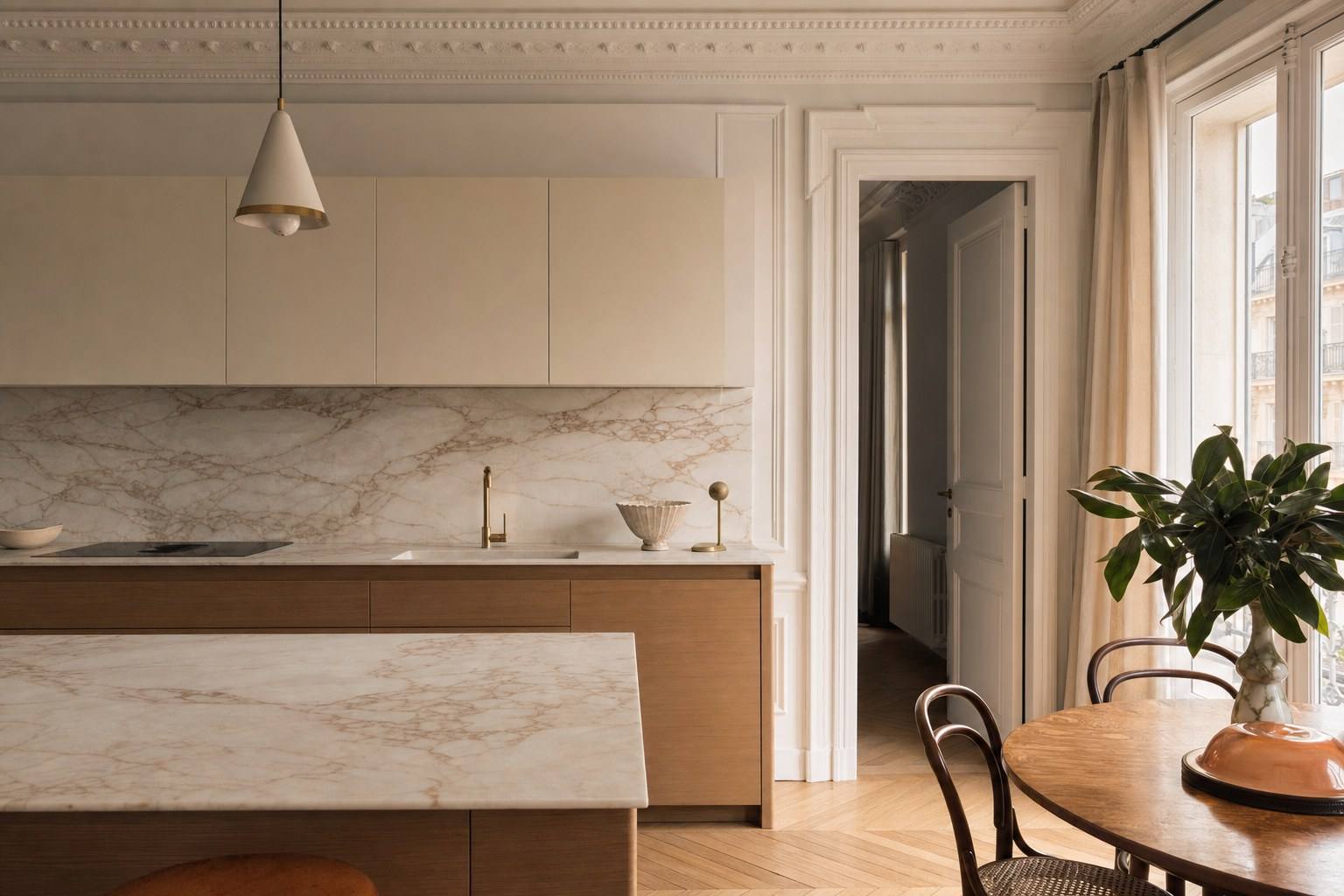
They are the two most technical rooms in an apartment, and paradoxically the ones where decisions are often the hardest to make. The kitchen and bathroom bring together plumbing, electricity, ventilation, appliances, everything the XIXᵉ century never planned for within its beautiful moulded volumes. Integrating them into a period setting means bringing together two opposing logics: ornamental richness on one side, functional demands on the other.
Yet the point is not to choose between them. These rooms may be the most technical in the apartment without ever giving up its character. Everything depends on how performance is dressed, how what should be concealed is hidden, and how what deserves attention is revealed. Here is how to strike that balance, room by room.
Integrating a modern kitchen into a period interior
A high-performance kitchen does not need to betray its surroundings. In a period apartment, the mistake is to treat the kitchen as a self-contained block, installed with no regard for what surrounds it. By contrast, a successful kitchen enters into dialogue with the room: it echoes its colours, respects its proportions and allows the original features to speak.
Let the architecture breathe
Before drawing a single cabinet, look at what the room already offers:
- a generous ceiling height, which would be a shame to flatten with full-height storage columns;
- mouldings and cornices that deserve to run freely, without being interrupted by a poorly placed cabinet;
- a period window and its light, to be preserved as the focal point of the room.
The ideal solution is often to concentrate storage along a single wall, or to introduce a central island, in order to free the surfaces where the historic architecture can speak for itself.
Open up without erasing
An open-plan kitchen adjoining the living room remains highly sought after, provided the transition is carefully handled. Continuous parquet flowing from one zone to the next, cabinet fronts in a shade that harmonises with the living-room walls, a slender glass partition rather than a solid wall: all are ways to connect spaces without blurring their identities. The kitchen then becomes a natural extension of the living area, not an add-on.
Discreet backsplashes, worktops and appliances
It is in the technical details that the coherence of a period kitchen is either won, or lost. The aim: for function to recede in favour of materiality.
Materials that echo the building
The worktop and backsplash are the most visible surfaces; they are also the easiest to align with the spirit of the place:
- natural stone and marble for a worktop that responds to the original fireplaces;
- zellige or artisanal tiles for the backsplash, whose irregularities bring an immediate patina;
- solid wood to warm the composition and echo the parquet;
- brass or patinated metals for taps and handles, rather than bright chrome.
These choices are often enough to anchor a contemporary kitchen in the story of a period apartment, without the slightest pastiche.
Conceal the performance
Modern appliances do not need to impose themselves visually. Integrated fronts, which conceal the refrigerator and dishwasher behind doors matching the rest of the cabinetry, preserve the overall reading of the room. The extractor hood, often unattractive, can disappear into a dressed housing or become retractable. As for handleless fronts with push-to-open mechanisms, they offer the smooth lines that contrast so beautifully with finely worked mouldings.
In brief: in a period kitchen, the contrast between contemporary equipment and historic décor can be embraced, but the technical elements must be dressed, noble materials, integrated fronts, patinated taps, so that they serve the space rather than compete with it.
Bathroom: marble, brass and comfort
The bathroom is the room where modern comfort is non-negotiable: heating, ventilation, a walk-in shower, carefully controlled lighting. It is also the room best suited to timeless elegance, provided the right materials are chosen.
The heritage trio
Certain materials move through time without ever appearing dated:
- marble, on the floor, vanity top or wall cladding, for inimitable depth and freshness;
- brushed or aged brass for taps and accessories, whose warm tone softens the whole;
- old-style tiling, cement tiles, tomettes, zellige, which gives the room decorative continuity.
Against this backdrop, a freestanding bathtub or countertop basin can create a focal point without excess.
Contemporary comfort, discreet but real
Behind this aesthetic, the technical execution must be impeccable. Effective ventilation is essential in a period apartment, where humidity can damage plasterwork and joinery. A heated floor or properly sized towel radiator, a level-access shower with fine glass screens, lighting that combines functional light near the mirror with ambient sources: all of this can be integrated without taking anything away from the character of the room. Here, luxury lies as much in invisible comfort as in visible materials.
Continuity of style throughout the apartment
The kitchen and bathroom are not islands. What distinguishes a fully resolved renovation from a simple collection of beautiful rooms is continuity: a shared vocabulary that runs from one end of the apartment to the other.
In practical terms, this coherence is built around a few constants:
- a master palette, neutral foundations, one or two deep accents, repeated in every room;
- a reference metal such as brass, used on the kitchen taps as well as in the bathroom;
- floors that respond to one another, through parquet in the living spaces and a complementary stone in wet rooms;
- a consistent treatment of joinery, doors and mouldings, visually linking the whole.
This shared grammar creates the sense of a home conceived in a single gesture. It is what transforms successful renovations into interiors that feel truly lived in.
Common mistakes of taste
A few missteps come up again and again, and are enough to upset the balance between heritage and modernity. Knowing them is already a way to avoid them.
The all-new look that erases history
Aiming for an entirely contemporary result often leads to hiding mouldings, covering parquet or closing off a fireplace. In doing so, you sacrifice precisely what gave the place its value. The rule: reveal before adding, restore rather than conceal.
Fake period style and too many references
Conversely, multiplying reconstructed “period” elements, poorly proportioned applied mouldings, falsely retro taps, an accumulation of patterns, creates a pastiche that quickly tires. One beautiful historic gesture is worth more than decorative excess.
Technical mistakes that prove costly
Finally, some mistakes are felt more in daily use than at first glance:
- neglecting the ventilation of a wet room, with the risk of damaging surfaces;
- underestimating lighting, settling for a central ceiling light that flattens the volumes;
- choosing fragile materials in a heavily used area, because maintenance has not been anticipated;
- forgetting storage, which eventually clutters the space and blurs its clean lines.
These decisions must be considered upstream, at the design stage, never in the urgency of the building site.
Reconciling the character of a period apartment with today’s comfort in its two most technical rooms means holding both requirements at once: the story of the place and everyday performance. This is precisely the territory Lumiera loves to explore, revealing the character of a Parisian interior while installing a decidedly contemporary kitchen and bathroom within it.
Planning a kitchen or bathroom project in a Paris apartment? Let’s talk about how to bring together, with precision, the charm of yesterday and the comfort of today.