
Lighting an Old Apartment: Working with Ceiling Height and Natural Light
Lighting an old apartment means reading the natural light, making the most of generous ceiling heights, and enhancing mouldings and fireplaces with a finely judged lighting scheme.
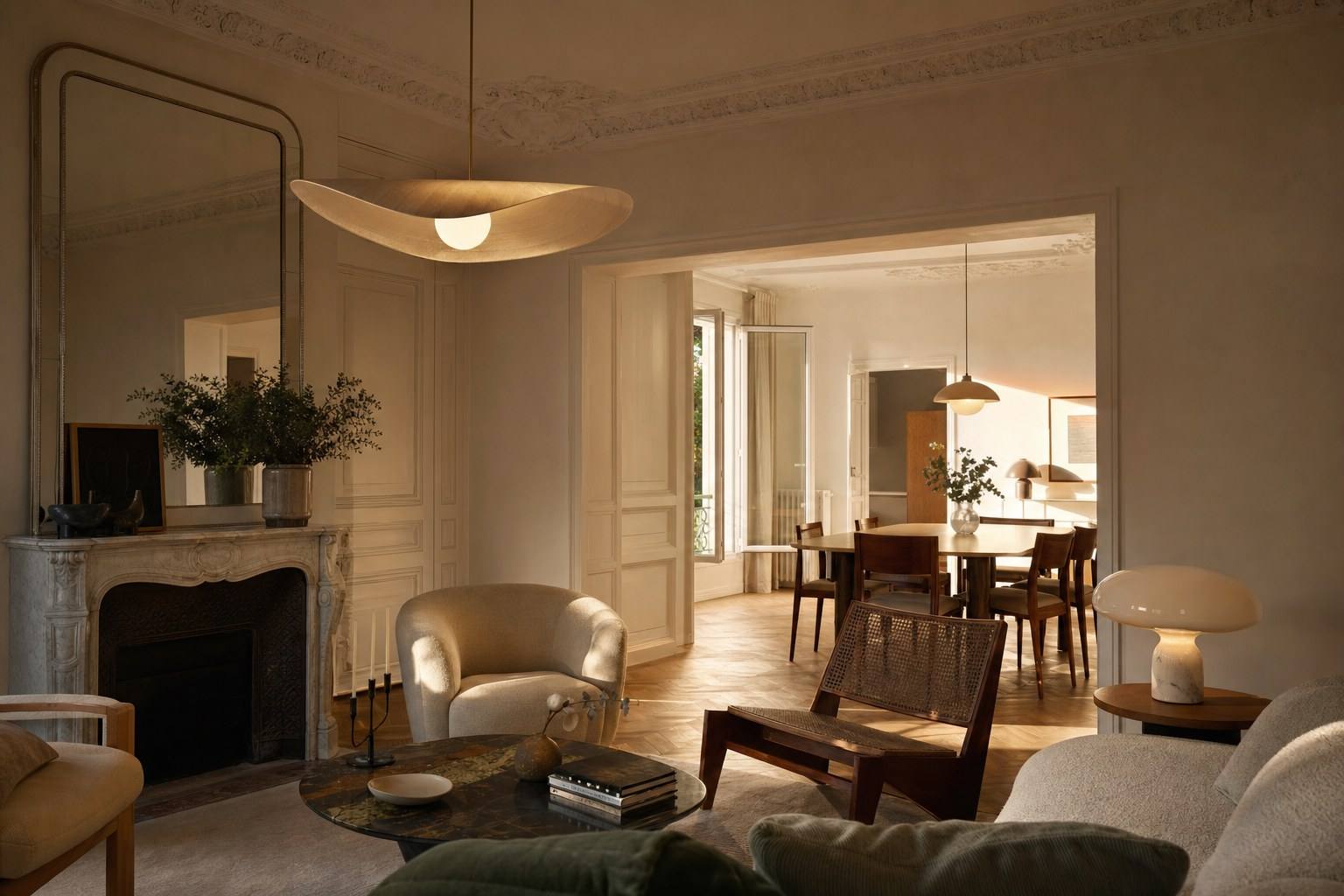
When Parisian buildings of the XIXᵉ century were designed, domestic electricity did not yet exist. Everything in their architecture was conceived to capture and circulate daylight: high ceilings, often close to three metres on the noble floors, expansive windows, and enfilades that allowed the sun to pass through the apartment from one room to the next. Natural light was not an amenity; it was the only true source of illumination.
Today, that legacy is as much an opportunity as it is a challenge. These generous volumes offer a sense of amplitude that recent constructions can never quite match; but they also call for thought. A three-metre ceiling, deep mouldings, a marble fireplace: each calls for light that is sculpted, not merely endured. Lighting an old apartment is not about adding points of light, it is about extending, once evening falls, what the architecture had originally intended for the day.
Reading the natural light of a home
Before choosing any light fitting, you need to observe. Every apartment has its own path of the sun, and understanding it shapes every decision that follows.
Spend a day watching how the light enters. A southern exposure bathes rooms in clear, warm light, generous though sometimes dazzling in summer. The north offers a soft, even, constant brightness, precious for an office or studio, cooler to live with. The east catches the morning sun, the west the more golden light of late afternoon.
A few simple instincts help make the most of it:
- Never obstruct the windows. Light sheers rather than heavy curtains, low furniture near openings: daylight remains the most beautiful and least costly source of light.
- Let brightness circulate with pale, matte surfaces that diffuse without glare, and mirrors placed opposite or perpendicular to a window to send light back into the heart of the room.
- Identify shadowed areas, often the back of rooms and corridors, which will need to be balanced with artificial lighting.
It is this initial reading that separates a successful lighting scheme from a mere accumulation of bulbs.
General lighting and accent lighting
A beautiful interior never relies on a single source. It is built in layers, each with its own function, to be adjusted according to the hour and the use.
General light
This is the background light, the one that makes a room usable. In an old home, it should be diffuse and discreet: it must not overpower the volumes or flatten the relief. A central pendant, wall sconces, indirect lighting that bounces off the ceiling, the aim is to create an even base, without harsh zones.
Accent light
This is what gives a room character. Directional and more intense, it draws the eye to what deserves to be seen: a section of wall, a bookcase, an artwork, an architectural detail. In an old apartment, it becomes the ideal tool for revealing heritage features.
Functional light
Finally, task lighting: for the worktop, the reading corner, the bathroom mirror. Precise and well positioned, it serves a gesture without lighting the whole room.
Layering these three registers, and being able to vary them, bright daylight in the afternoon, a subdued atmosphere in the evening, is what transforms a correctly lit home into a place that feels truly good to live in.
In brief Three layers to combine: soft general light as the base, directional accent light to reveal the décor, and precise functional light for everyday gestures. The richness of a room is born from their dialogue, never from a single source.
Pendants and generous ceiling heights
The ceiling heights of older apartments are an invitation. Where a recent apartment demands flat ceiling lights, the haussmannien apartment allows for a gesture: the pendant can drop lower, gain presence, occupy the void.
A few principles for making the most of it:
- Dare to use volume. A large light fitting, a generous pendant or a contemporary chandelier inhabits the vertical space rather than leaving it empty. In a three-metre-high room, a small pendant looks lost.
- Pay attention to the hanging height. Above a table, the bottom of the light fitting is generally placed 70 to 85 cm from the tabletop: high enough not to interrupt sightlines, low enough to create intimacy. In an entrance hall or stairwell, the pendant can drop more boldly to animate the verticality.
- Work with existing ceiling roses. Many old apartments retain a plaster ceiling rose. Hanging a light fitting from it, whether antique or resolutely modern, creates an immediate dialogue between the original ornament and a contemporary gesture.
A haussmannien light fitting does not necessarily mean a crystal chandelier. A contemporary piece beneath old moulding often creates the most compelling contrast, that tension between eras which gives Parisian interiors so much of their charm.
Highlighting mouldings and the fireplace
This is where light reveals its magic. Nothing enhances relief like lighting designed for it, and old interiors are full of relief.
Mouldings and cornices are revealed by grazing light. A source placed close to the wall and directed upwards emphasises the profile lines: the cast shadows bring out each groove, each ovolo, transforming a simple plaster band into a graphic composition. Indirect lighting concealed in a cornice, skimming the ceiling, produces the same effect with softness while visually enlarging the room.
The marble fireplace, the natural focal point of the living room, benefits from being accentuated. Two symmetrical sconces, a discreet light placed on the overmantel or directed towards the mantelpiece, restore the presence it deserves, even if no longer in use, it remains the heart of the room.
The principle, in every case: light that caresses rather than overwhelms. Frontal lighting flattens; grazing or indirect lighting reveals. It is this nuance that separates a wall that is merely lit from a wall that is staged.
Colour temperature and atmospheres
One final parameter, often overlooked, changes everything: colour temperature, expressed in kelvins (K). It determines whether a light feels warm and enveloping or cold and clinical.
- 2 700 K, a warm, amber light, close to a flame. This is the register for living spaces: sitting room, bedroom, dining room. It flatters the warm tones of old interiors, wood, brass and the patina of parquet.
- 3 000 K, a warm white, slightly brighter, pleasant for a kitchen or bathroom without tipping into coldness.
- 4 000 K and above, a neutral to cool white, useful for a worktop or functional space, but to be used sparingly: in an old living room, it drains the warmth from the materials.
Beyond kelvins, two reflexes make the difference. Prioritise faithful colour rendering, a high index accurately restores the tones of walls, fabrics and artworks. And vary the intensity with dimmers: the same room can be bright and luminous in the afternoon, then soft and intimate in the evening. It is this ability to modulate light that gives an interior its soul, hour by hour.
Extending the original intention
Lighting an old apartment is, at heart, an exercise in reading before it is an exercise in installation. Understanding where daylight enters, respecting the volumes the architecture intended, revealing the mouldings and fireplace rather than drowning them in uniform light: every decision flows from what the place is already saying. Successful artificial light is light that seems to have always been there.
This is precisely the attention Lumiera brings to its Parisian projects: considering lighting not as a technical addition, but as the natural extension of a place’s character, that sensitive dimension which transforms a beautiful apartment into a lived-in interior.
An old apartment to reveal? Let’s talk about how light can restore its full presence, day and night.