
Mouldings, Ceiling Roses and Cornices: A Short Illustrated Lexicon of Parisian Plaster Décor
Corniche, rosace, cimaise, staff: decode the plaster décor of Parisian apartments, learn to read a home’s period and understand how to showcase it.
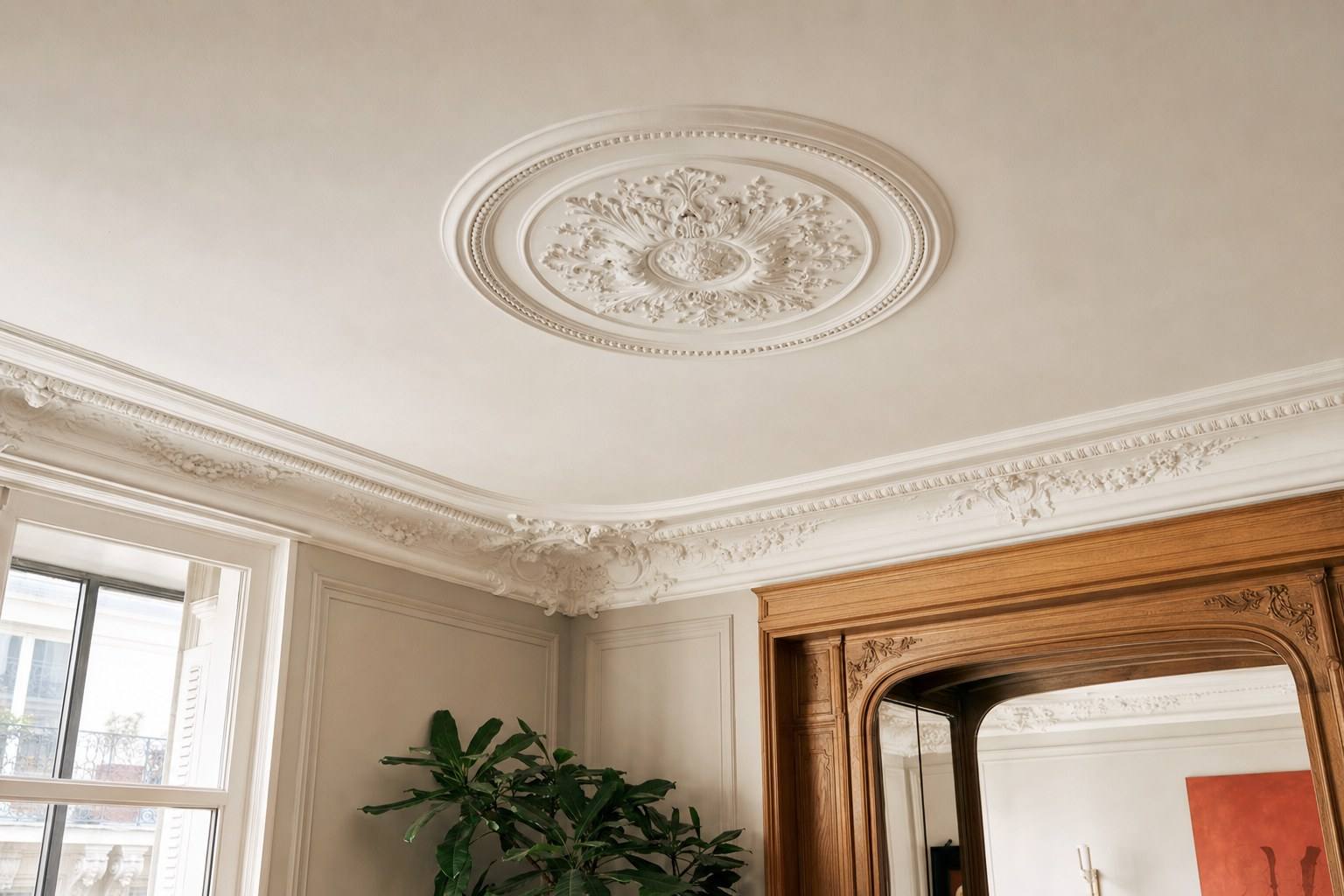
Look up in an old Parisian apartment: above you, an entire vocabulary unfolds in relief. A corniche runs along the ceiling, a rosace (ceiling rose) crowns the light point, and sometimes a frieze edges the top of the walls. We often look at these details without truly seeing them, as if they were simply part of the scenery. Yet this worked plaster is anything but incidental: it is a language, with its own grammar and styles, telling the story of the period, status and intention of the person who built it.
Plaster décor is a true stylistic signature, a period marker as reliable as an engraved date. An exuberant botanical motif, a sober geometry, a garland of flowers: each betrays its century and its taste. Learning to name these elements gives you the tools to understand an apartment, and, when the time comes, to restore or reinvent it without betraying its spirit. Here is how to decipher what is happening above our heads.
A vocabulary worth knowing: corniche, rosace, cimaise, staff
Before reading a decorative scheme, you first need to know how to name it. A few terms come up again and again, and confusing them can quickly lead to misunderstandings when describing a project to a craftsperson.
The elements of the décor
- The corniche: the horizontal moulding that emphasises the junction between wall and ceiling. It may be discreet, reduced to a simple rounded cove, or spectacular, with layered rows of ornament, dentils, egg-and-dart, acanthus leaves.
- The rosace (or rosette): the circular ornament, often centred, that decorates the ceiling and historically surrounded the lighting point. This is where the pendant or chandelier would have been fixed.
- The moulding: a generic term for any raised profile, whether it runs along a wall, frames a door or forms part of a corniche. By extension, haussmannien mouldings refer to the whole ornamental repertoire of XIXᵉ-century apartment buildings.
- The cimaise: originally, the upper moulding of a cornice; in everyday usage, the horizontal rail set halfway up the wall, which once protected tapestries and today serves as a reference line for hanging framed works.
- The staff: not a motif, but a material and a technique, a fibre-reinforced plaster, cast in a workshop, that made it possible to produce this décor in series. We return to it below.
This lexicon is not merely for purists. Naming precisely what you see is already the first step towards caring for it.
Reading an apartment’s period through its mouldings
Plaster décor is a remarkable chronological clue. Even without knowing the year of construction, a reasonably trained eye can place an interior within a few decades simply by observing the design of its corniches and rosaces.
The main style families
- Classicism and the Second Empire (mid-XIXᵉ century): this is the golden age of the haussmannien building. The décor is rich yet ordered, inspired by Antiquity and the Renaissance. You find acanthus leaves, egg-and-dart, beading, rows of dentils, garlands of flowers and fruit. Corniches are deep, hierarchical and often more generous on the étage noble than on the upper floors.
- The post-haussmannien and Belle Époque style (around 1900): the repertoire becomes more supple. Motifs grow more fluid, garlands lighter, sometimes tinged with the spirit of Art Nouveau, with its botanical curves and undulating lines.
- The interwar period and Art Deco (années 1920-1930): a clear break. Décor becomes geometric, simplified and stylised. Rosaces turn into radiant compositions with taut lines; corniches are pared back into crisp stepped profiles. Ornament becomes graphic.
To this stylistic reading, one can add a social reading, specific to the Parisian building. Décor was modulated according to the floor: profusion on the noble levels, increasing sobriety as one climbed towards the attic, where the service rooms most often had no mouldings at all. Spotting sumptuous décor, or, conversely, a very pared-back scheme, says a great deal about the room’s original purpose.
Staff, stucco or plaster: three techniques not to confuse
We readily speak of “plaster mouldings”, but behind that phrase lie several crafts, with very different properties and costs. Distinguishing between them is essential before any intervention.
Plaster worked in situ
The décor could be shaped directly on site. The ornamental plasterer would run corniches by hand using a calibre, a metal profile template guided along a rule, through the still-fresh plaster. More complex elements, such as rosaces, were modelled or cast on the wall. This is demanding craftwork, in which every piece is subtly unique.
Staff
Staff is a fine plaster reinforced with fibres, cast in moulds in the workshop and then fixed to the ceiling. Popularised in the XIXᵉ century, it democratised decorative plasterwork: corniches and rosaces could be reproduced identically, in quantity, and installed quickly. Most of the ceiling rosaces we admire today are made of staff. Light and reproducible, it is particularly well suited to restoration: a missing piece can be recast from the neighbouring model.
Stucco
Stucco belongs to a different logic. It is a coating made from lime and marble powder, polished at length, which imitates marble and offers a lustrous, deep, almost translucent surface. It is used more for walls and columns than for ceilings. Rarer and more costly to execute, it belongs to a specialist trade.
In brief, Plaster is the base material, worked by hand on site. Staff, fibre-reinforced plaster cast in a mould, made it possible to produce décor in series: it is what you find in the majority of rosaces. Stucco, made from lime and marble, imitates polished stone and is used mainly on walls.
Restoring, completing or recreating identically
Plaster décor rarely survives the decades without a few knocks. Cracks, chips, accumulated paint layers that clog the reliefs, sections lost during earlier works: there are many scenarios. The right response always depends on the actual condition and heritage value of what remains.
- Restore: this is the preferred option whenever original décor survives. The mouldings are freed from excess paint thickness to recover the crispness of the modelling, cracks are filled, and detached elements are resecured. The gesture is one of revealing rather than replacing.
- Complete: when a portion is missing, a corniche interrupted by an old partition, a damaged rosace, an impression can be taken from an intact section to recast the lost part. When well executed, the join becomes invisible. This is where staff shows its full value.
- Recreate identically: when the décor has disappeared entirely, or when two rooms with different corniches are combined, it must be recreated. The design is then based on profiles still present in the apartment, or on the repertoire of the period, to restore a drawing coherent with the place.
The guiding principle remains the same: respect the original logic. An Art Deco corniche has no place in a Second Empire salon, and the reverse is just as true. The right décor is décor attuned to its period and its room.
Integrating them into a contemporary interior
Far from being a constraint, plaster décor is a powerful ally for today’s interiors. The key is to stage it rather than endure it, and to resist the temptation to neutralise it beneath a uniform white.
A few approaches work particularly well:
- Use colour on the ceiling. A dark or deep shade between the mouldings, with the raised details kept light, reveals the corniche’s design and gives the room depth.
- Embrace the contrast of styles. Resolutely contemporary furniture, clean lines, a graphic light fitting: nothing enhances an old rosace better than a dialogue with the present.
- Treat the rosace as a work of art. Rather than hanging a chandelier from it by default, you can let it breathe, or pair it with understated lighting that allows it to be seen.
- Edit. In an apartment with abundant décor, highlighting everything eventually flattens everything. Choosing what to bring forward restores hierarchy to the space.
The common thread: consider these reliefs as living heritage, to be brought into dialogue with its time rather than frozen beneath a neutral coat.
Reading, naming, restoring and then showcasing this décor all require the same eye: one that recognises in a corniche something more than a decorative ornament, the memory of a place and its time. This attentive reading of heritage, combined with the demands of contemporary comfort, is what guides every project undertaken by Lumiera.
A rosace to reveal, a corniche to extend, an old interior to reinvent? Let’s talk about how your décor can recover its full presence.