
Parquet à la française, point de Hongrie and bâtons rompus: three centuries beneath our feet
From Versailles parquet to haussmannien floors: the history of point de Hongrie and bâtons rompus, and how to restore antique parquet in Paris.
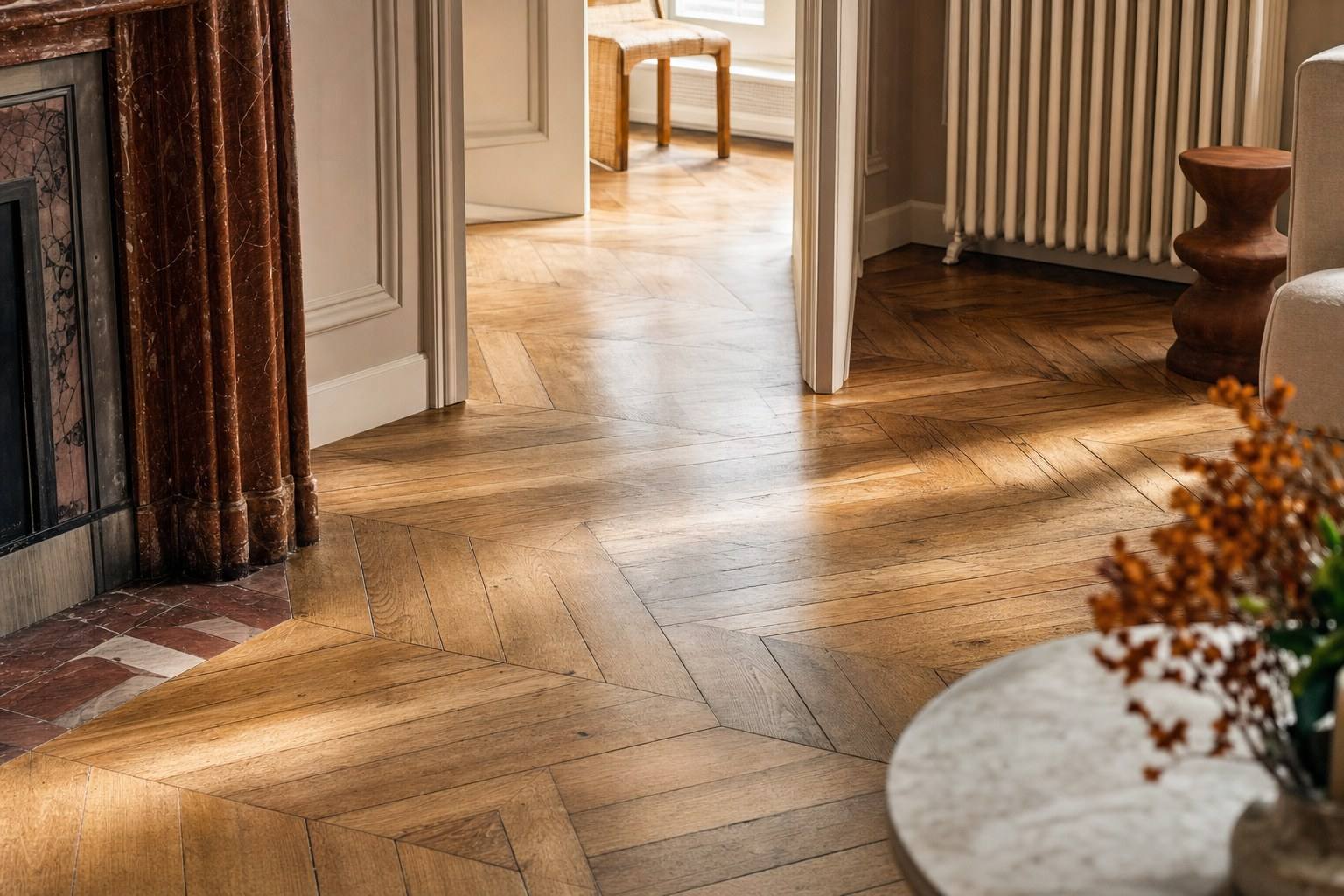
We look up at the mouldings, linger over the marble fireplace, photograph the light-filled enfilade. And we almost always forget to look at what, in fact, holds everything together: the floor. The parquet in a Paris apartment is not merely a floor covering, but a piece of cabinetmaking laid directly underfoot, a design intended to be seen, a legacy that has carried the weight of footsteps through the centuries.
This story begins long before the boulevards. In the XVIIᵉ century, at Versailles, terracotta tiles, cold and difficult to maintain, were gradually replaced by oak assemblies in sophisticated patterns. The celebrated “parquet de Versailles”, with its latticework panels, became a mark of royal refinement. From the court, the fashion spread to the hôtel particulier (private mansion), then, two centuries later, to the bourgeois apartment building. When Haussmann redrew Paris, point de Hongrie became an obvious choice for the salon. What we walk on today in a Paris apartment descends, quite directly, from château floors.
At the beginning: Versailles, chevrons and point de Hongrie
Before it became Parisian, patterned parquet was French in the most classical sense of the word: born of a very practical need, to make stone floors cleaner and warmer, it quickly flourished into a decorative art. Three major families of pattern run through this history:
- The Versailles panel: strips assembled into frames and latticework, forming large, regular squares. Sumptuous and demanding, it remains the preserve of exceptional residences.
- Chevrons (or bâtons rompus): straight-cut strips laid end to end to create a succession of V shapes. This is the oldest and most widespread pattern, the one that “breaks” the line at each row.
- Point de Hongrie: the elegant cousin of the chevron, with strips cut on the bias (at 45 or 60 degrees) and joined point to point, without interruption. The eye then follows long, continuous ridges running from one wall to the other.
The distinction between the two often escapes the hurried eye. Yet it is essential: in bâtons rompus, the ends of the strips meet at right angles; in point de Hongrie, they meet on the bevel, forming a true point. From this cut comes a different impression, more rustic and graphic in one case, silkier and more elongated in the other.
Why point de Hongrie defines the Parisian bourgeois apartment
If one pattern had to sum up the haussmannien interior, it would be this one. Point de Hongrie became the preferred choice for the reception rooms of the Parisian bourgeoisie for reasons of both aesthetics and use.
Its long diagonal lines lead the eye towards the window and the light, extending the perspective of the enfilade: in a long salon, the pattern stretches the space rather than breaking it up. It converses with the other decorative codes, mouldings, cornices, fireplace, without ever competing with them: the floor gives structure, the walls provide ornament.
There is also an element of social distinction. Laying point de Hongrie required more skill and more material than a simple plancher à l’anglaise (straight, parallel boards). The pattern therefore signalled, discreetly, the status of the apartment: it was readily reserved for the salon and dining room, while bedrooms and service areas made do with a more restrained installation. Even today, discovering original point de Hongrie beneath forgotten carpet is, for a Parisian owner, a small celebration.
Timbers, patinas and laying directions
An old parquet floor can be read like a text: the timber, the tone, the orientation of the strips all reveal its age and quality.
Oak, almost always
In the vast majority of Paris apartments, the wood is oak: dense, stable and resistant, it ages magnificently. Fir or pine can sometimes be found in secondary rooms and more modest upper floors, softer and less noble species.
Patina, the value money cannot buy
What gives an old parquet floor its worth is time. Under the effect of light, wax and footfall, oak develops a patina: a deep, warm, slightly irregular colour that no new product can truly imitate. Small imperfections, knots, grain, subtle relief, are part of this character. A parquet floor that is too perfect has often lost its soul; a patinated parquet has gained one.
Laying direction, a precise vocabulary
The orientation and assembly of the strips follow certain rules:
- Pose “à la française”: strips of varying widths and lengths, assembled with a certain freedom. This is the tradition, supple and alive.
- Pose “à l’anglaise”: regular strips of the same width, aligned in rows, later, more mechanical.
- Point de Hongrie and bâtons rompus: patterns in their own right, whose direction, towards the window, along the axis of the room, enhances light and proportions.
Understanding this vocabulary gives you the means to respect a parquet floor rather than work against it.
Restore or replace: what should be done with an old parquet floor?
The question always comes eventually. The parquet creaks; the strips are grey, stained, sometimes gaping. Should it be saved or replaced? The answer almost always leans towards restoration, provided there is a proper diagnosis.
An old solid oak parquet floor has a considerable reserve of material. Unlike modern engineered floors, it can be sanded several times over the course of its life. Where many see a tired floor, there is often a magnificent parquet simply waiting to be awakened.
The steps of a well-executed restoration follow a clear order:
- Diagnose: identify the timber, measure the remaining thickness, locate damaged strips, moisture, any insect attacks and the condition of the substrate.
- Repair rather than replace everything: selectively replace unsalvageable strips with reclaimed old timber, secure those that move, and treat the wood if needed.
- Sand with restraint: remove wear and old finishes without unnecessarily “eating into” the material or erasing its relief.
- Protect and nourish: choose a finish consistent with the history of the parquet, oil or wax for an authentic matt appearance, vitrification for greater resistance in heavily used rooms.
Complete replacement should remain a last resort: a floor too thin to be sanded again, structural damage, an original pattern irretrievably lost. And when relaying is truly necessary, real luxury lies in sourcing reclaimed old parquet rather than imitating the past with something new.
The mistakes that “kill” an old parquet floor
A century-old parquet floor is robust, but a few unfortunate decisions are enough to erase what three centuries have built. The most common are:
- Covering it without thinking. Laying tile, laminate or glued-down carpet over original point de Hongrie is tantamount to condemning a work of art. What lies beneath is almost always worth more than what is placed on top.
- Over-sanding. Sanding too aggressively, or repeatedly without necessity, flattens the relief, lightens the wood excessively and cuts into the precious reserve of material. One does not merely sand an old parquet floor; one reveals it.
- Choosing an anachronistic finish. A thick, glossy vitrified finish on patinated oak freezes the floor into a “new” and plasticised appearance, against its character. The finish should serve the wood, not disguise it.
- Ignoring wood and humidity. Old parquet remains a living material: it fears excess humidity as much as dryness, and a neglected leak or a careless treatment can compromise the whole floor.
- Entrusting old strips to hurried hands. Recalibrating a pattern, reworking a bevel cut, matching reclaimed timbers: these are the gestures of an artisan. Treated like an ordinary building site, an exceptional parquet floor can be made banal in a matter of days.
Behind each of these mistakes lies the same misunderstanding: believing that an old parquet floor is a problem, when it is in fact a heritage to pass on.
Restoring an old parquet floor means listening to what the place has already said, then carrying it forward without betraying it, recognising, in an oak pattern laid a century ago, the same exacting standard that once governed château floors. At Lumiera, every project begins with this way of looking: identifying what has value, preserving it, and bringing the best of the old into dialogue with the comfort of today.
An original parquet floor may be sleeping beneath your feet. Let’s talk: discover our approach, designed to reveal the character of the old and make it last.