
Parquet, Mouldings, Fireplace: Restoring the Heritage Trio (and Finding the Right Craftspeople)
Restoring parquet, mouldings and a fireplace in a period Paris apartment: diagnosis, heritage craft techniques, specialist artisans and the coordinator’s role.
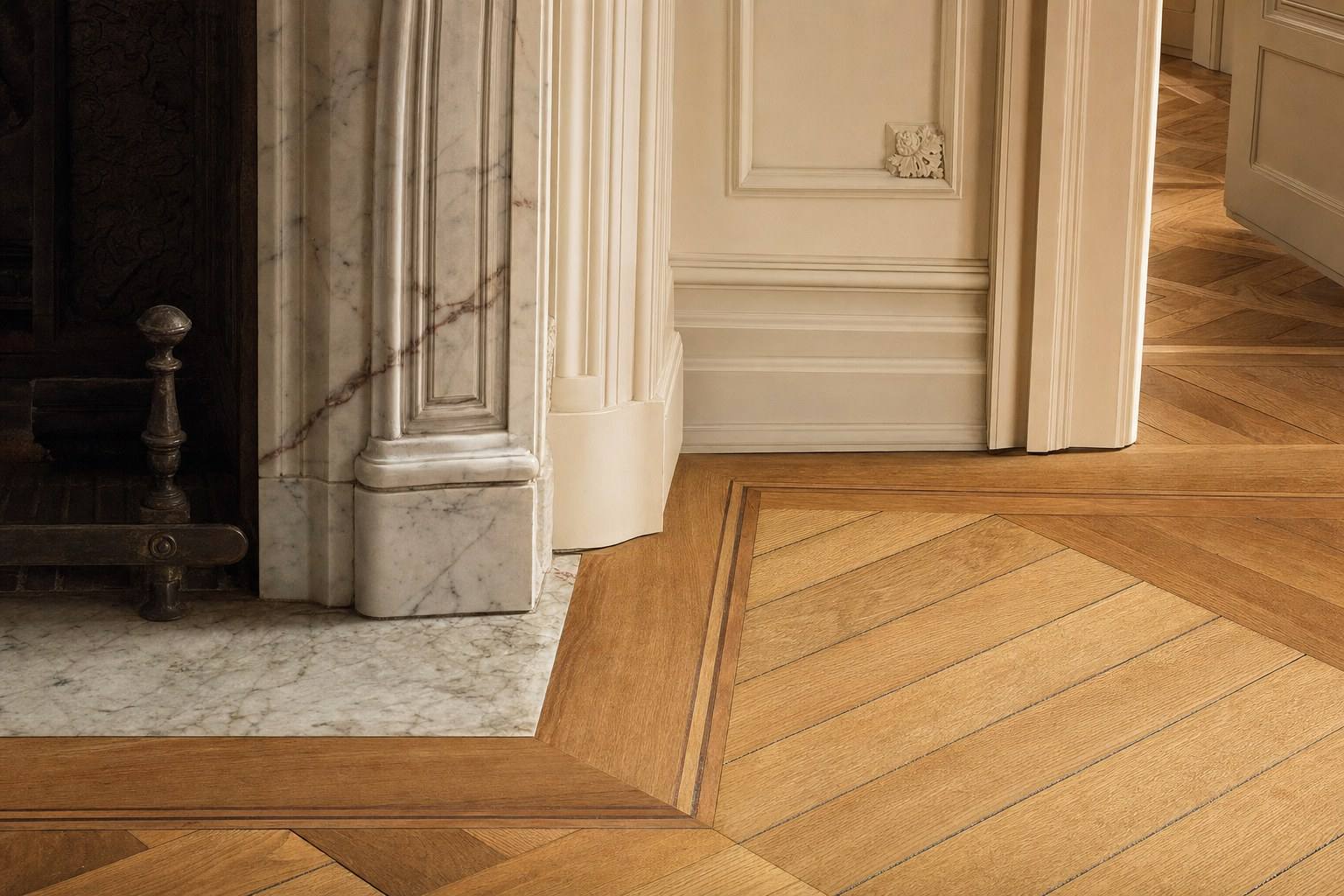
In a period Paris apartment, three elements hold almost the entire soul of the place: the parquet that creaks underfoot, the mouldings that trace the ceiling, and the marble fireplace that anchors the living room. This trio is anything but incidental. It tells the story of an era, a way of building, an art de vivre, and it is often what people bitterly regret losing when a clumsy renovation has erased it. Bringing these original features back to life cannot be improvised: it requires precise know-how, the kind that distinguishes restoration from simple renovation.
The good news is that this heritage can almost always be saved. Blackened parquet can be sanded back and recover its glow; damaged mouldings can be rebuilt in staff plasterwork; a sealed fireplace can be reopened. But first you need the right diagnosis, an understanding of the craft involved, and the right artisans around you. This guide walks you through the restoration of this heritage trio, element by element.
At a glance
- Old parquet can almost always be restored: sanding, targeted replacement of boards, oil or matt varnish finish. Allow 80 to 200 €/m² for a careful refurbishment.
- Mouldings and staff plasterwork can be repaired and recreated like for like: crack repairs, on-site moulding, reinstatement of missing elements.
- The fireplace can be cleaned, restored and, if the flue allows, brought back into use (open fire, insert or decorative feature).
- The key to success: artisans specialised in heritage work and a coordinator to orchestrate their interventions in the right order.
Indicative 2026 price ranges, to be refined with a detailed quotation.
Diagnose before touching anything
No serious restoration begins with a sander. It begins with observation. Before committing to any expense, you need to assess the existing condition honestly and distinguish superficial wear from issues that threaten the material itself.
A few diagnostic reflexes:
- The parquet: look for gaping boards, hollow areas (a sign of tired joists or insect damage), deep stains and the remaining thickness of the wood. Solid parquet can be sanded several times over its lifetime; parquet that has already been thinned significantly calls for greater caution.
- The mouldings and staff plasterwork: look for cracks, detachment, accumulated layers of paint that “drown” the relief, and sections that have simply disappeared during previous works.
- The fireplace: check the condition of the marble or stone, whether a flue is present and in what state, and ask a qualified chimney-sweeping professional whether it can be brought back into service.
This diagnosis is not a mere formality: it determines the budget, the sequence of works and the choice of craftspeople. In period properties, wisdom always lies in observing before acting.
Restoring old parquet
Parquet is undoubtedly the most rewarding element to restore: the result can be spectacular, while the cost remains reasonable in relation to the value it gives back to the property. Parquet point de Hongrie, herringbone or wide English-style boards: every pattern deserves to be preserved rather than covered over.
The stages of refurbishment
- Filling and repairs: boards that are too damaged are replaced with reclaimed boards of the same wood species, loose boards are re-secured, and gaps are filled.
- Sanding: carried out in several passes, from the coarsest to the finest grit, it reveals the sound wood beneath the patina and old finishes.
- The finish: this sets the tone. Hardwax oil preserves a warm, authentic look that is very faithful to the spirit of a period interior; a matt varnish offers greater protection and is well suited to high-traffic rooms.
Mistakes to avoid
- Sanding parquet that is already too thin without professional advice.
- Choosing a finish that is too glossy, which betrays the character of old wood.
- Covering original parquet with a contemporary floor without careful thought: it almost always impoverishes the property.
Repairing mouldings and staff plasterwork
Cornices, ceiling roses, frames: plaster decoration is the handwriting of Parisian ceilings. This is workshop-level craft, carried out by a staffeur-ornemaniste, an artisan capable both of repairing what exists and recreating missing parts.
What a good professional knows how to do:
- Repair cracks and breaks without crudely concealing them, while respecting the original profile.
- Free up the relief suffocated by decades of paint, restoring the crisp line of the moulding.
- Reinstate missing elements: using a surviving section, the artisan makes a mould and recreates an absent cornice or ceiling rose like for like.
- Blend old and new invisibly when a room has been opened up or reconfigured.
Well-restored plaster decoration is barely noticeable, and that is precisely the sign of successful work. Reinstating these reliefs gives the ceiling back the depth and grazing light that make period interiors so charming.
Showcasing a fireplace
The fireplace is the living room’s anchor point, even when it no longer provides heat. Too often sealed, overpainted or hidden, it usually asks above all to be revealed.
Cleaning and restoring the firebox
Marble that is grimy, yellowed or stained can be cleaned and renovated by expert hands; chips can be reattached, missing parts reconstructed. An original cast-iron fireback, a stone surround or an antique overmantel deserves the same care as a valuable piece of furniture.
Three possible uses
- Decoration: the simplest solution. The flue remains closed, and the fireplace becomes a focal point, perhaps dressed with candles or a bespoke insert.
- An insert or stove: if the flue is sound and compliant, a closed firebox provides genuine heating comfort while preserving the aesthetic.
- An open fire: rarer in co-owned buildings and subject to conditions, it requires a strict inspection of the flue and the building regulations.
In every case, bringing a flue back into service is the responsibility of a qualified professional: safety and compliance come before aesthetics.
Choosing specialist artisans (and the coordinator’s role)
This is the point that makes all the difference. Restoring the heritage trio involves distinct trades: a parquet specialist, a staffeur-ornemaniste, a marble worker or stonemason, sometimes a chimney specialist for the flue. Each is a specialist, and rarely a generalist.
How to recognise the right artisan
- A restoration portfolio, not just new installation work: ask to see projects in period properties, with before-and-after images to support them.
- Precise trade vocabulary: a good professional talks about wood species, profiles, moulds and finishes, not generalities.
- A sense of heritage: the desire to preserve and reinstate rather than replace for convenience.
- Verifiable references in buildings comparable to your own.
Why a coordinator changes everything
Bringing together good craftspeople is not enough: they must also intervene in the right order. You do not apply the finish to parquet before the plaster repairs to the ceiling are complete; you protect a restored fireplace while neighbouring works are under way. This sequencing, these interfaces, this protection of fragile elements: that is the coordinator’s craft.
It is also the philosophy of integrated renovation championed by Lumiera: a single point of contact who knows the right Parisian heritage artisans, orchestrates their interventions and ensures that every original element is protected, restored and enhanced, never sacrificed to the pace of the building site.
Restoring parquet, mouldings and a fireplace does not mean renovating against the history of a place: it means renovating with it. Done well, this work gives a Paris apartment something no new material can imitate, its memory.
Have you inherited parquet, mouldings or a fireplace waiting to be revealed? Entrust us with a diagnosis: we will identify the heritage potential of your apartment and the artisans capable of restoring its radiance.