
Project Manager, Interior Architect, General Contractor: Who Does What?
Project manager, interior architect or general contractor: who should you hire for a Paris renovation? Roles, differences and a clear method for choosing the right partner.
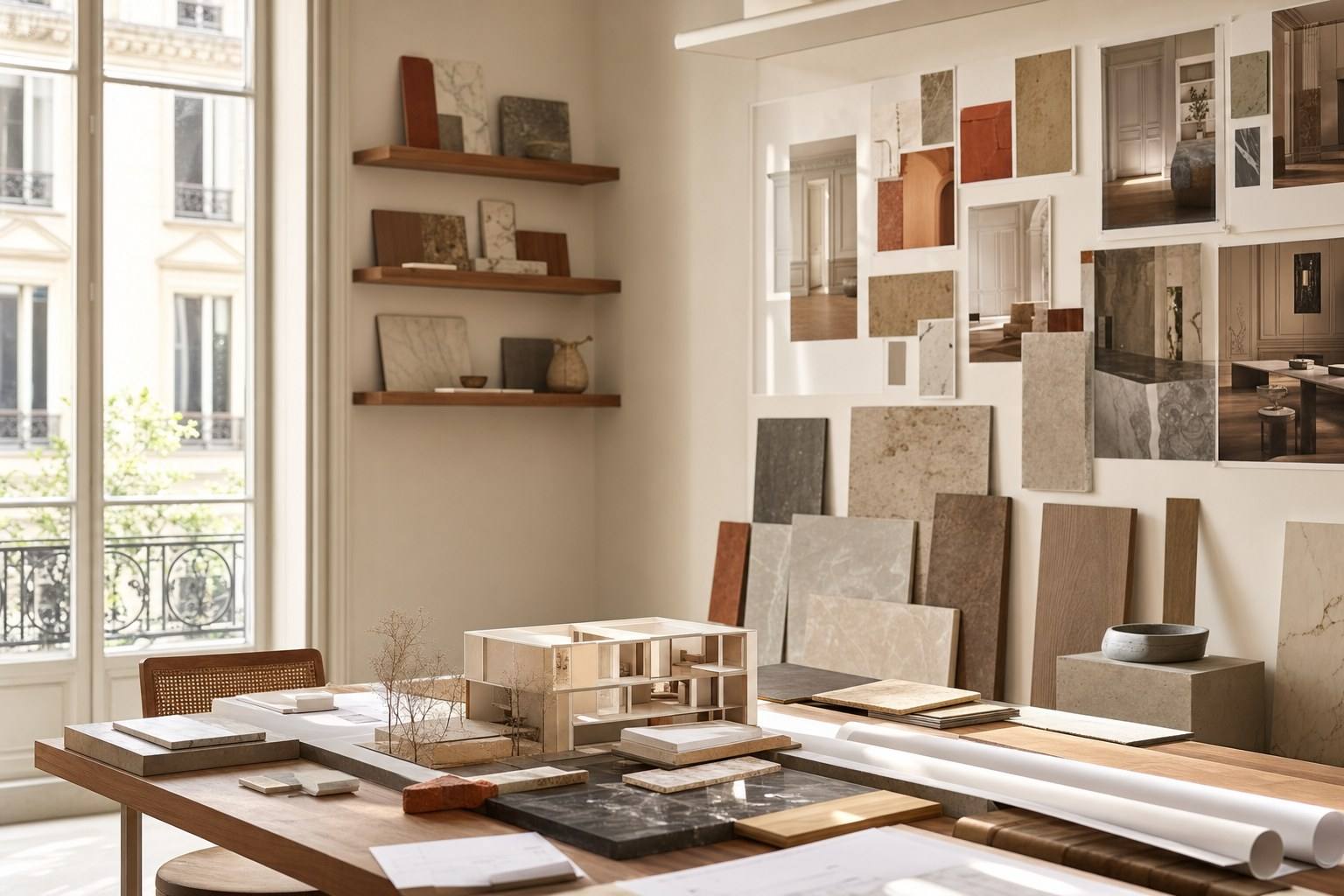
Before choosing a tile or a parquet finish, every Paris homeowner faces a more prosaic, yet decisive question: who should you entrust with the work? Maître d'œuvre, interior architect, general contractor, engineering office… the titles sound similar, sometimes overlap, and the language of construction does little to clarify matters. Understanding each profession is already a step towards choosing the right partner, and often, avoiding the misunderstandings that prove most costly.
Behind these terms lie very different responsibilities: designing, coordinating, executing, guaranteeing. A single project may bring together three or four separate parties, or just one, depending on how it is organised. This guide reviews each role, clears up the most common areas of confusion, and gives you a simple method for identifying the right point of contact for your project.
In brief
- The interior architect conceives and draws the spaces: they think through use, light, volumes and materials.
- The maître d'œuvre organises and coordinates the site: they manage the contractors and ensure that deadlines, budget and quality are respected.
- The general contractor (TCE) carries out the works, with all trades brought together under a single signature.
- The maître d'ouvrage is you: the owner who commissions and finances the project.
- The integrated model brings design, coordination and execution together through one single point of contact.
The interior architect: thinking through the space before building it
The interior architect is the project designer. Their work begins well before the first hammer stroke: they analyse your apartment, listen to how you live, then imagine a new organisation of the volumes. Redistributing rooms, opening up a kitchen, creating an additional shower room, allowing light to travel from one façade to the other, this is their territory.
In practical terms, their role spans several areas:
- Design: plans, sections, perspectives, choice of materials and colours, bespoke furniture drawings.
- Aesthetics and coherence: they give the project an overall direction, so that each room speaks naturally to the next.
- Respect for the existing fabric: in Paris, in older properties, this means working with mouldings, a fireplace, parquet point de Hongrie or a ceiling height that deserves to be enhanced.
Interior architect or architecte DPLG?
The distinction is worth clarifying. An architect in the strict sense, registered with the Ordre, is the only professional authorised to submit a building permit and to work on a building’s structure and façades. The interior architect focuses on interior layouts, spatial planning and decoration. For the vast majority of Paris apartment renovations, involving partitions, services and finishes, but not heavy structural work, the interior architect is the relevant point of contact. As soon as a project modifies the façade or the structure of the building, the involvement of an architect registered with the Ordre becomes necessary.
Maître d'œuvre and maître d'ouvrage: do not confuse the two
This is the most common confusion, because the two terms differ by only one word, yet describe opposite roles.
The maître d'ouvrage is you
The maître d'ouvrage is the client: the owner who decides to renovate, defines the brief, approves the choices and finances the works. They commission the project. You are the maître d'ouvrage of your own apartment.
The maître d'œuvre orchestrates the site
The maître d'œuvre, by contrast, is the project’s conductor. They do not lay the tiles or pull the cables: they coordinate those who do. Their role notably includes:
- consulting contractors and analysing quotes;
- planning and monitoring the site, trade by trade;
- checking the quality of execution and compliance with the plans;
- managing the budget and schedule through to handover.
In other words, the maître d'ouvrage states what they want; the maître d'œuvre ensures that it is delivered as planned. Good project management is often what separates a calm renovation from one you merely endure.
The general contractor and TCE: execution under a single signature
The third category of professionals is made up of the companies that actually carry out the works. We speak of a general contractor when a single company takes charge of all trades, masonry, electrical work, plumbing, joinery, painting, rather than relying on independent craftspeople recruited one by one.
This is the meaning of the acronym TCE, for tous corps d'état, or all trades. A TCE contract brings every technical package of a project together under one signature. The advantage is twofold:
- One contract, one responsible party for execution, rather than multiplying contractors and potential points of friction.
- Internal coordination between trades, with the company itself managing the sequence of interventions.
The trade-off to understand is this: a general contractor executes a project, but does not necessarily design it. It needs plans and decisions to be finalised upstream. This is why, on an ambitious project, it ideally comes in after a design phase, unless design and execution are brought together within the same model.
The integrated model: one point of contact, from idea to handover
Traditionally, these professions are separate. The owner appoints a designer, then a maître d'œuvre, then contractors, and in practice finds themselves acting as the link between parties who share neither the same contract nor the same interests. This is where grey areas appear: a detail missing from the plan, a quote interpreted differently, a responsibility passed from one party to another.
The integrated model responds precisely to this difficulty. It brings design, coordination and execution together under one roof:
- Design: the interior architect draws the project.
- Coordination: the maîtrise d'œuvre manages the site.
- Execution: the all-trades teams carry out the works.
For the owner, the difference is tangible: one point of contact, one contract, one budget, from the first sketch to handover. No more back-and-forth between parties, no more diluted responsibilities: the person who designed the project is also the one who brings it to completion, and who answers for it. This is the approach championed by Lumiera, designed so that nothing is lost between the initial intention and the finished result.
How to choose according to your project
The right partner depends on the nature and scale of your works. A few pointers will help you situate your project.
A simple refresh
Paintwork, flooring, a few repairs: a trusted craftsperson or small company may be enough. The need for design and coordination remains limited.
A complete renovation with a new layout
As soon as you are reworking the fit-out, moving partitions or rethinking the layout, design becomes decisive and the coordination of several trades essential. An interior architect working with a maître d'œuvre, or an integrated model that brings the two together, then makes perfect sense.
A high-end or heritage project
Restoring period features, integrating bespoke elements, aiming for an impeccable finish in a haussmannien apartment: this level of expectation calls for close management and complete continuity between design and execution. This is where the integrated model truly comes into its own.
To decide, ask yourself three simple questions: does my project affect the layout of the rooms? how many trades will be involved? do I have the time and inclination to coordinate the different parties myself? The more your answers point towards scale and complexity, the more valuable a single point of contact becomes.
Choosing the right partner is not an administrative formality: it is the first decision that shapes the serenity of the entire renovation. A well-entrusted project is one in which everyone knows who does what, and where the owner simply watches their apartment take shape. This is the clarity Lumiera places at the heart of the way it renovates in Paris.
Have a project in mind and unsure where to begin? Let’s talk: we will help you frame your renovation and identify, together, the right starting point.