
The Parisian Artist’s Studio: A History of Verrières and North Light
The rise of artists’ studios in Montmartre and Montparnasse, the secret of the verrière and north light, and how to renovate a studio without betraying its soul.
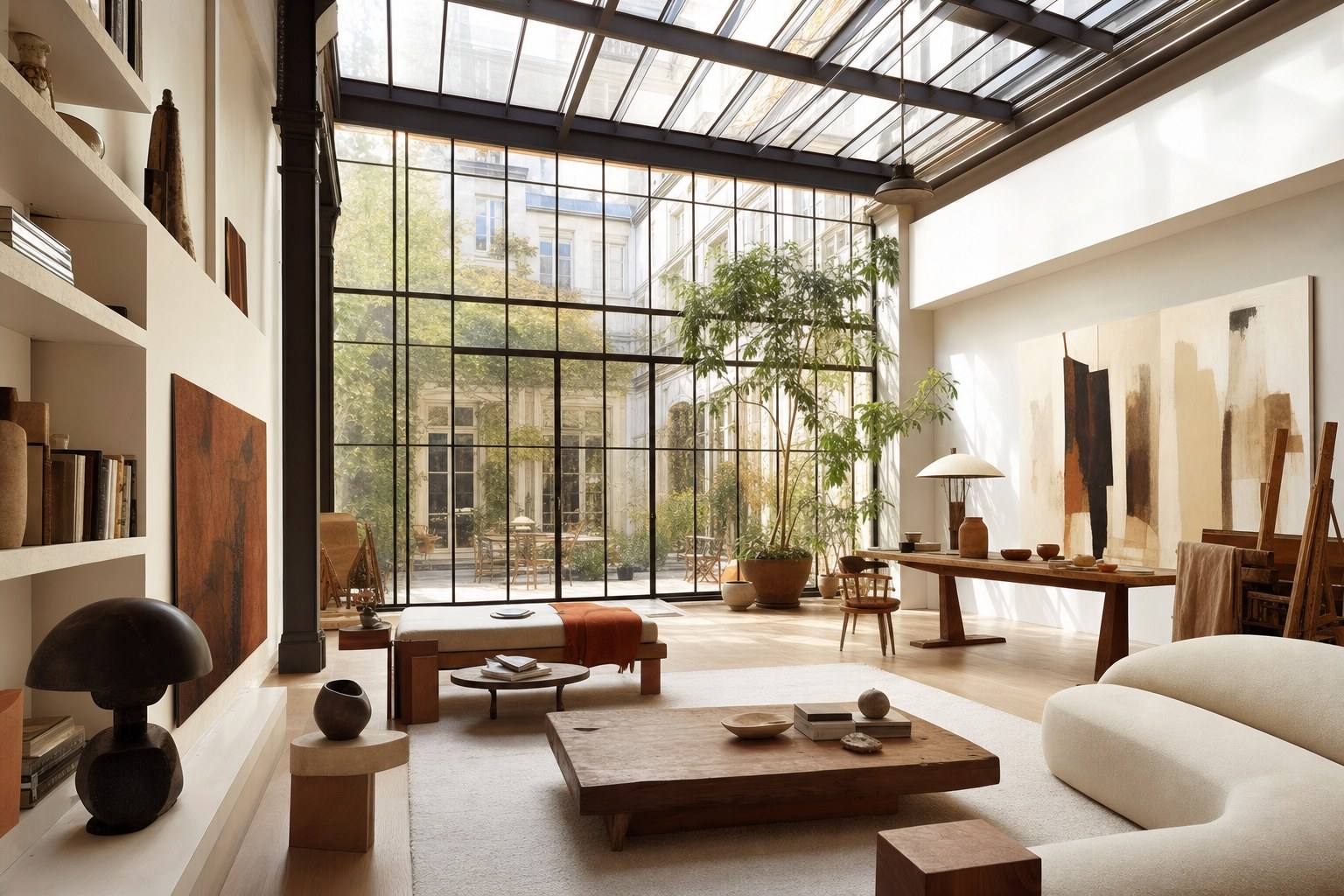
In certain streets of Montmartre or Montparnasse, you need only look up to recognise them: those broad glazed façades tilted towards the sky, gridded with slender metal mullions, catching the light in a way no neighbouring window quite does. They are the remnants of a Paris that, at the turn of the XIXᵉ and XXᵉ centuries, imagined itself as the world capital of the arts. Between the Butte and the Vavin crossroads, painters, sculptors and photographers arrived in their hundreds, and they needed somewhere to live, but above all, they needed what no ordinary dwelling could provide: light, abundant light, and the right kind.
Behind the studio verrière, now one of the most coveted features on the Paris property market, lies a very practical working requirement. This great wall of glass was not an aesthetic whim: it answered to a science of light that artists understood and passed on. To understand its history is to understand why a studio cannot be renovated like an apartment, and why its soul lies entirely in its relationship with daylight.
Origins: Paris, capital of artists
At the turn of the century, Paris exerted an unrivalled pull on artists from all over the world. The city concentrated the academies, the Salons, the dealers, the galleries, the cafés where the avant-gardes were debated. For a painter, coming to Paris meant coming to the place where the art of one’s time was being made.
This influx created a need for dedicated workspaces, distinct from simple housing. Two neighbourhoods would come to embody this creative ferment.
- Montmartre, up on the heights, with its modest rents, gardens, low houses and still village-like atmosphere, welcomed an entire generation at the end of the XIXᵉ century.
- Montparnasse, on the Left Bank, took over at the beginning of the XXᵉ century and became the heart of an international bohemia whose intensity remains legendary.
To meet the demand, a new kind of building was constructed, conceived entirely around the studio: vast double-height rooms, often extended by a mezzanine used as a sleeping area, and above all fitted with the immense verrières that are now their signature. Some artists’ communities, grouped around a courtyard or planted passageway, formed true little worlds where people worked door to door.
North light: a choice that was anything but accidental
The most surprising feature of these studios, for those who do not know them, is their orientation: the large verrière almost always faces north. It seems counterintuitive, we usually seek the sun, yet in reality it follows a rigorous working logic.
A constant light without harsh shadows
Light from the north never brings direct sunlight. It is diffuse, soft and remarkably stable from morning to evening. For a painter, this is a decisive advantage:
- colours appear under a neutral, faithful light that does not distort the tones of a painting;
- the absence of direct sun prevents hard-edged shadows and blinding reflections on the canvas or model;
- the stability of this light makes it possible to work for hours without the scene changing with every movement of the sun.
Where a south-facing sitting room offers warmth and shifting brilliance, the north-facing studio offers something more precious for creation: constancy.
A verrière designed as a tool
The very form of the verrière stems from this purpose. Tall, often partly sloping, it captures light from the sky rather than from the horizon and lets it fall into the room like a sheet. Its slender metal mullions, generally painted dark, structure the surface without weighing it down. Curtain or blind systems were often added to temper the intensity according to the hour and season. Nothing about this feature is merely decorative: everything is a matter of craft.
From studio to loft: a long evolution in use
The story of these places did not end with their golden age. On the contrary, it followed the transformations of the city.
After the effervescence of the first decades of the XXᵉ century, many studios changed purpose. Some remained places of creation, passed from artist to artist. Others were converted into homes, attracting buyers sensitive to their extraordinary character: that volume, that height, that light found nowhere else in the classic haussmannien urban fabric.
The major cultural shift came later, with the fashion for the loft. The idea of living in vast open floor plates inherited from work rather than from bourgeois domesticity gave these spaces immense desirability once again. Long before the word “loft” took hold, the Parisian artist’s studio already contained all its essential DNA:
- a single, generous volume, often double-height;
- a mezzanine that naturally separates day and night;
- a spectacular influx of light through the verrière;
- a freedom of layout that few homes can offer.
Today, to own an authentic artist’s studio in Paris is to hold a fragment of that history, a rare property, sought after as much for its story as for its qualities of use.
The verrière today: between true architecture and decorative nod
The success of the verrière has spread far beyond its original setting. It is now found everywhere, to the point that two very different realities must be distinguished.
The “authentic” studio verrière
This is the original glazed wall, or one faithfully restored: a façade or section of façade in glass and metal that brings in exterior light and forms part of the building envelope itself. It belongs to architecture, involves the structure and, in a copropriété as under planning regulations, is never altered lightly.
The “interior” or decorative verrière
This is the highly fashionable glazed partition installed inside a home to separate a kitchen from a living room, or to create a study without blocking the light. It borrows the language of the studio, slender mullions, clear glass, dark finish, but its role is quite different: it organises space and allows daylight to circulate from one room to another.
Both have their legitimacy. The first is a heritage element to be preserved; the second, a contemporary design tool that, when used with restraint, can enter into a beautiful dialogue with the spirit of a place. The pitfall would be to confuse them, or to pile up decorative references until the authenticity of the whole is lost.
Renovating a studio without betraying its spirit
To renovate a studio is to accept a fruitful constraint: everything must serve the light and the volume, which are its reason for being. A few principles guide the most successful projects.
- Preserve the light above all. The verrière and its orientation are the heart of the property. The glazing is restored, the metal mullions treated against corrosion, thermal and acoustic performance improved, without ever reducing the glazed surface or changing the nature of the light.
- Respect the volume. The temptation to partition a large open floor plate in order to multiply rooms always comes at the expense of light and spaciousness. It is better to structure the space with mezzanines, split levels or glazed divisions than with solid walls.
- Reconcile charm with contemporary comfort. Insulation, heating, electrics, the watertightness of the verrière: these invisible works determine the real comfort of a studio, which is often more exposed to temperature variations than a conventional apartment. Much of the project’s success is decided here.
- Work with the rules. Any intervention on a verrière facing the exterior affects the façade, and therefore the copropriété and sometimes heritage protections. Preliminary diagnostics and authorisations are part of the project, not side issues.
Ultimately, the challenge is the same as for all Parisian heritage: to introduce the comfort of the XXIᵉ century without erasing what makes the place unique. A successful studio is never one that has been turned into an ordinary apartment, but one whose light has been revealed, that demand for precision which guides every project undertaken by Lumiera.
Do you own an artist’s studio or Parisian loft and wish to restore it to its full radiance? Let us explore together how to preserve its soul while making it wholly liveable today.