
Art Deco in Paris: The History of a Style and How to Reinterpret It at Home
The origins of Parisian Art Deco, its codes and signature materials, and how to reinterpret this iconic style at home without slipping into pastiche.
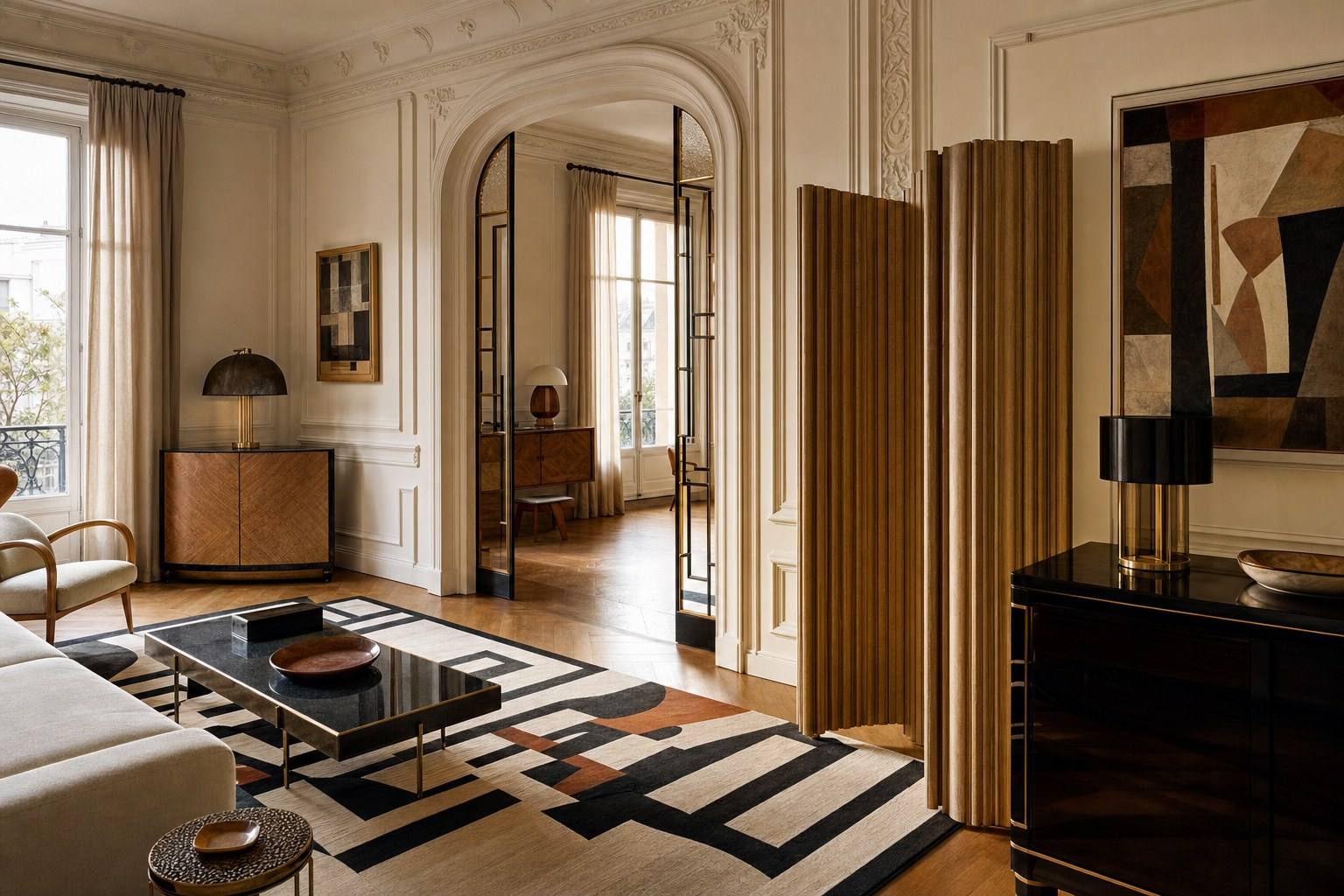
Polished brass, deep lacquer, fan-shaped geometric motifs, veined marble and precious wood panelling: Art Deco instantly evokes a certain vision of Parisian luxury, that of grand ocean liners, hotel lobbies and softly lit salons of the années folles. We sometimes imagine it frozen in its era. Yet in its time, it was the most modern, most confident expression of refinement, a style conceived for a world that was accelerating.
Its birth certificate has a precise date and place. In 1925, Paris hosted the Exposition internationale des arts décoratifs et industriels modernes, a vast showcase that would give the movement its name and establish the capital as the epicentre of a decorative golden age. Understanding this history is not merely a matter of curiosity: it is a way to grasp what makes Art Deco so instantly recognisable, and how to capture its spirit at home without turning an interior into a museum.
The Birth of Art Deco: 1925 and Its Codes
In the aftermath of the First World War, a generation longed to turn the page. The 1920s were an age of speed, jazz, the automobile, early aviation and assertive modernity. Art Deco was born of that energy: resolutely contemporary, yet unwilling to relinquish the excellence of fine craftsmanship.
The 1925 Exposition was its manifesto. Across the pavilions erected along the Seine, a new grammar took hold, in clear contrast to the botanical curves and arabesques of the Art Nouveau that preceded it. Where Art Nouveau drew inspiration from nature and its sinuous lines, Art Deco chose discipline: straight lines, symmetry, controlled volumes.
Its founding codes are easy to identify:
- a confident geometry: chevrons, zigzags, fans, circles and stepped motifs that sometimes evoke ziggurats or the emerging skyscrapers of the age;
- an ordered symmetry, structuring both furniture and façades;
- a taste for luxury and craftsmanship, with noble materials worked by exceptional cabinetmakers, lacquerers and ironworkers;
- a stylisation of forms, where a flower, gazelle or wave becomes a pared-back, almost abstract motif.
It is this distinctive tension, between industrial modernity and artistic savoir-faire, that gives Art Deco its singular elegance, at once structured and sumptuous.
Signature Materials and Motifs
A style is recognised first through its palette of materials. Art Deco has its own, immediately identifiable, built around contrasts and surfaces.
Noble Materials
- Brass and gilded metals, used throughout, draw fine, luminous lines: light fittings, handles, furniture legs and mirror frames.
- Lacquer, often black or deep red, brings smooth, reflective surfaces inspired by the Far Eastern refinement so admired at the time.
- Veined marbles, black, green, or beige with pronounced veining, dress fireplaces, tables and floors.
- Precious woods (ebony, rosewood, elm burl) and geometric veneers, beloved by the great cabinetmakers of the period, give structure to furniture.
- Velvet and heavy textiles, in rich tones, envelop seating and soften the rigour of the lines.
Recurring Motifs
Ornament here is never gratuitous: it creates rhythm and structure. We find fan motifs (the famous “sunburst” or rising sun), chevrons, geometric friezes, fluting and checkerboards. Nature, when it appears, is always stylised: frozen bouquets, symmetrical foliage, pared-back animal silhouettes.
The colour palette favours strong contrasts: black and gold, emerald green, deep blue, burgundy, often lifted with a touch of cream white or powder pink.
Identifying Art Deco in a Parisian Home
In Paris, Art Deco did not merely furnish interiors: it shaped entire buildings, mainly constructed between the late 1920s and the mid-1930s. After the reign of the haussmannien style and then the Art Nouveau interlude, these buildings mark a new layer in the capital’s architectural landscape.
A few clues can help identify a home from this period:
- stone façades with lines that are more understated and more vertical than the haussmannien, sometimes animated by geometric bas-reliefs or stylised ironwork;
- balconies and wrought-iron railings with angular, fan-shaped or graphic scroll motifs;
- entrance doors and building lobbies of particular refinement, where the finest elements are often concentrated, geometric stained glass, mosaics, original light fittings;
- joinery and stained glass built around abstract compositions, far removed from floral motifs;
- inside, marble fireplaces with clean lines, granito (terrazzo) or graphic tiled floors, and volumes that are often more rational than in older properties.
Recognising these signatures already means understanding the heritage value of a place, and knowing what should be preserved when the time comes to renovate.
Reinterpreting Without Creating a “Museum” Effect
This is the main pitfall when one loves a historic style: accumulation. Multiplying brass, lacquer, velvet and fan motifs in every corner ultimately produces a reconstructed décor, fixed in time and slightly theatrical. The aim is not to reproduce the 1920s, but to capture their spirit.
A few principles help strike the right balance.
Use It in Measured Touches
A few strong gestures are better than saturation. A sunburst mirror, a pair of brass wall lights, a sideboard with geometric veneers: one or two elements per room are often enough to establish the Art Deco signature, provided they are given space to breathe.
Anchor It in a Contemporary Base
Art Deco feels more modern when it enters into dialogue with contemporary lines. Walls in soft or assertive tones, pared-back furniture, then a few signature pieces: the contrast showcases the style far better than an already busy setting. It is this dialogue between heritage and modernity that creates the most balanced interiors.
Reinterpret the Motifs
There is no need to multiply friezes. A geometric motif can appear in bathroom tiling, a kitchen splashback, a rug or wallpaper on a single feature wall. Used sparingly, it evokes the period without imitating it.
Invest in Craftsmanship
Art Deco was a matter of artisanship. Recovering that spirit is less about the number of objects than their quality: fine ironwork, true lacquer, carefully executed joinery are worth more than ten decorative accessories. It is the refinement of the execution that creates authenticity.
In brief, To reinterpret Art Deco without a “museum” effect: a few well-chosen signature pieces, a calm contemporary base, geometric motifs used with restraint, and an uncompromising approach to the quality of materials and finishes.
Rooms and Details Where It Works Best
Not every space lends itself to Art Deco in the same way. Certain rooms, by virtue of their use or atmosphere, welcome it with particular ease.
- The entrance and hall. As a place of transition, the entrance can readily support a bold gesture: a sunburst mirror, a brass console, a checkerboard floor. With little furniture, it allows the detail to fully express itself.
- The bathroom. This is perhaps the most naturally Art Deco space. Black-and-white geometric tiles, gilded taps, marble, brass-framed mirrors, vertical wall lights: the style finds an ideal setting here, both graphic and luxurious.
- The living room. A few velvet seats, a fireplace with clean lines, a sculptural light fitting and one or two lacquered pieces are enough to establish the atmosphere without weighing down the living space.
- The kitchen. A geometric splashback, brass handles, a marble or veined-stone worktop: the modernity of appliances pairs surprisingly well with these retro nods.
- The details, everywhere. Door handles, switches, light fittings, frames: it is often in these discreet elements that the style expresses itself with the greatest finesse, with minimal risk of excess.
Art Deco shines through the precision of its details more than through their abundance. Well distributed, it runs through a home like a guiding thread, present without ever imposing itself.
Reinterpreting such a codified style requires both decorative culture and true technical mastery, knowing which original elements to restore, which materials to choose, and where to place the right gesture. This balance between respect for heritage and contemporary interpretation guides every project undertaken by Lumiera, creating interiors that speak of an era without ever being confined to it.
An apartment from the années folles to elevate, or the desire for an Art Deco touch in your Parisian interior? Discover our approach, designed to unite the character of the old with the comfort of today.