
How Much Does an Apartment Renovation Cost in Paris in 2026? A Detailed Budget per m²
Paris apartment renovation prices per m² in 2026: ranges by scope of work, itemized costs, a worked example and a method for securing your budget.
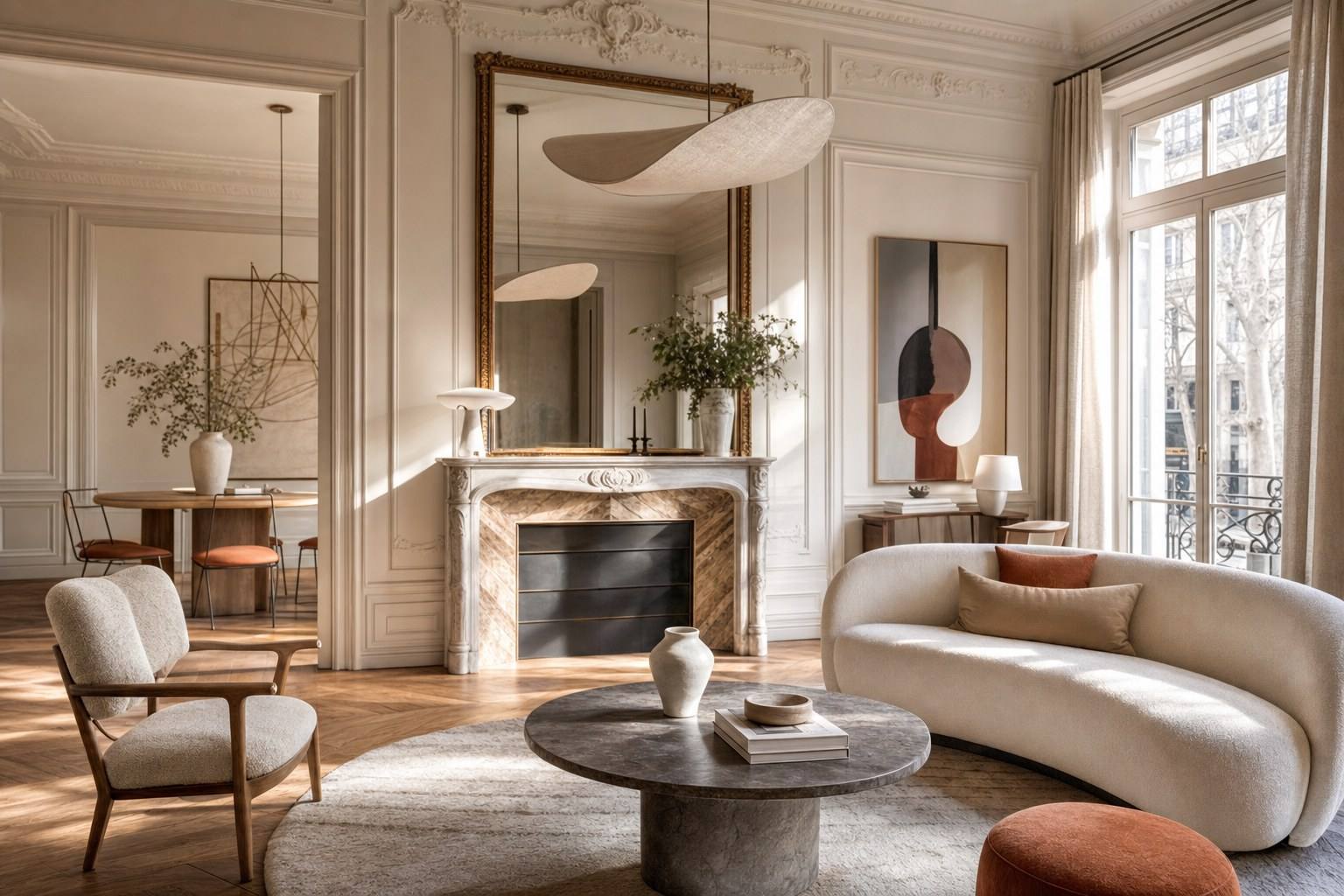
It is the first question every Paris homeowner asks, and the hardest to pin down. The cost of a renovation depends on so many variables (the condition of the property, the scope of the work, the level of finish, the constraints of period buildings) that no single price can be meaningful. What does exist, however, are reliable ranges that make it possible to frame a project even before the first quotation. Here is how to approach it.
In brief
- Cosmetic refresh (paint, flooring, minor repairs): approximately 400 to 800 €/m².
- Full renovation (all finishing trades renewed, without major structural work): approximately 1 200 to 2 000 €/m².
- Heavy or high-end renovation (new layout, structural work, premium materials): 2 000 to 3 500 €/m² and more.
- In Paris, allow for an uplift linked to site constraints (access, co-ownership rules, parking).
Indicative 2026 ranges, to be refined without exception through a detailed quotation.
Three levels of renovation, three budgets
Before discussing figures, it is essential to define precisely what you want to do. Renovation projects are typically divided into three levels.
1. The cosmetic refresh
Neither the structure nor the service networks are altered. Paint, repairing or replacing flooring, touching up a few elements: the apartment is already sound, and the aim is to restore its appeal. This is the most economical category, at around 400 to 800 €/m².
2. The full renovation
This is the most common scenario when buying a home to live in. All the finishing trades are redone: electrics brought up to standard, plumbing, heating, insulation, kitchen, bathroom, floors and paintwork. The room layout remains broadly unchanged. Expect 1 200 to 2 000 €/m², depending on the level of finish.
3. The heavy or high-end renovation
The apartment is redesigned: partitions may be removed, the kitchen opened up, a bathroom relocated, and sometimes a load-bearing wall modified. Noble materials and bespoke joinery are often added to the brief. The budget then rises to 2 000 to 3 500 €/m², and can exceed that ceiling for a particularly demanding project.
Costs by trade
A global price “per m²” conceals very different realities. To build a realistic budget, it is better to think by work package. Below are indicative 2026 price ranges for a good-quality renovation in Paris:
- Electrical work (complete upgrade to current standards): approximately 80 to 150 €/m².
- Plumbing (renewal of pipework): approximately 60 to 120 €/m², excluding fixtures.
- Fitted kitchen (installation + cabinetry, excluding high-end ranges): from 5 000 to 15 000 €, depending on finishes.
- Bathroom (full renovation): 8 000 to 20 000 € per room, depending on surface area and materials.
- Flooring: parquet from 60 €/m², tiled flooring supplied and installed from 70 €/m²; restoring old parquet often falls between 40 and 90 €/m².
- Paintwork and finishes: 30 to 60 €/m² of treated surface.
- Windows and joinery (double-glazed windows): 600 to 1 200 € per window, more for heritage-style models.
These sums add up quickly: that is why a full renovation rarely stays below 1 200 €/m² once you are aiming for a genuine level of finish.
A worked example: a 60 m² apartment to renovate completely
Take a 60 m² period apartment in Paris, to be renovated from top to bottom without structural changes. At 1 500 €/m² (the middle of the range for a carefully executed full renovation), the works budget comes to around 90 000 €.
To this, you need to add design and project-management fees, surveys, and a contingency allowance. The overall budget can easily reach 100 000 to 110 000 €. If the project includes a new layout or high-end materials, it can approach, or even exceed, 140 000 €. These figures are indicative for 2026: only a detailed quotation can make them reliable.
What drives up the bill in a period property
In Paris, most renovated apartments are period properties, often haussmanniens. This heritage has a cost, and it should be anticipated.
- Bringing installations up to standard: outdated electrical systems or lead plumbing must be fully replaced.
- Hidden networks and defects: in period buildings, surprises sometimes emerge during the works (damaged floor structures, damp, asbestos in old coverings) that are invisible at first glance.
- Heritage restoration: repairing old parquet, restoring mouldings or a fireplace requires specialist craftsmanship, and therefore costs more than a standard new installation.
- Energy improvement: insulating without distorting the property’s character, replacing windows while respecting the original aesthetic, these items weigh on the budget, but add lasting value to the home.
- Parisian site constraints: upper floors, no lift, difficult access, co-ownership rules and restricted noisy-work hours extend timelines and increase labour costs.
The budget items people often forget
A realistic budget is not limited to the cost of the works. Remember to include:
- fees for project management or an interior architect (generally a percentage of the works budget);
- mandatory insurance and surveys;
- permissions (prior declaration, co-ownership approval);
- a contingency allowance, in period properties, setting aside a 10 to 15 % reserve is basic prudence;
- furniture and finishing touches (lighting, appliances, bespoke storage), which are often underestimated.
How to make your budget reliable
Three habits help avoid unpleasant surprises.
- Obtain a detailed quotation, item by item. Be wary of global, non-itemized “per m²” prices: they conceal considerable differences.
- Compare like for like. Two quotations are comparable only if they describe exactly the same services and the same materials.
- Anticipate available grants and incentives. Depending on the works (especially energy upgrades), MaPrimeRénov', the éco-PTZ or a reduced TVA (VAT) rate can help reduce the bill. We cover this in a dedicated guide.
A controlled budget begins with a well-defined project
The truth is that the cost of a renovation is determined as much upstream, during the design phase, as it is on site. A clearly defined project, costed item by item and managed with rigour, is the best safeguard against overruns.
This is the principle behind integrated renovation: a single point of contact who designs, costs and coordinates the whole project, with total budget transparency at every stage. At Lumiera, every Paris project is conceived this way, so that the initial quotation closely matches the final invoice.
Would you like a reliable budget for your apartment? Request a personalised estimate: we will cost your project item by item, with complete transparency.