
Noble, Durable Materials: Lime, Terracotta, Brass and Stone, Why They’re Making a Comeback
Lime, terracotta, brass and stone: yesterday’s materials are returning to renovation. How they unite heritage, ecology and lasting elegance in Paris.
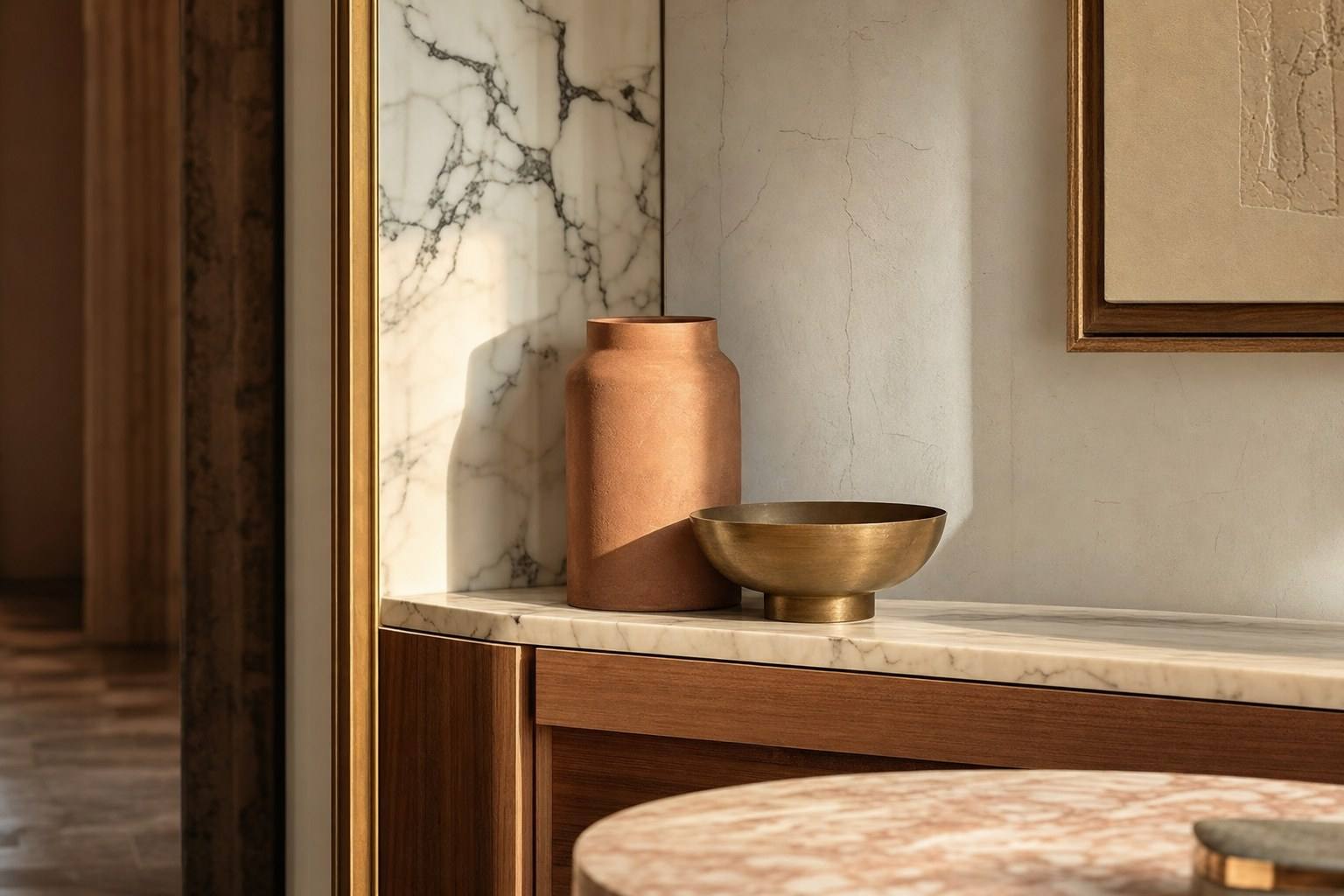
For decades, we thought we were doing the right thing by covering stone with plasterboard, hiding tomettes beneath linoleum, replacing brass with chrome. Modernity, we believed, was measured by the disappearance of the old. Today, the tide has turned. On the finest Parisian renovation sites, cement renders are stripped back to rediscover lime, forgotten terracotta tiles come to light, and brass handles are chosen precisely because time will give them a patina. These materials from the past respond, almost without our realising it, to the challenges of the present.
Their return is far more than decorative nostalgia. Lime lets old walls breathe, terracotta endures for centuries without faltering, brass can be repaired rather than discarded, and stone never goes out of style. At a time when we speak of carbon footprints, bio-based materials and sustainable renovation, these skills and finishes, long considered outdated, feel strikingly current. To understand why they are coming back is to understand what truly gives an interior lasting value.
Lime: the material that lets old buildings breathe
Before cement, there was lime. For millennia, it was used to build walls, create renders and protect façades. Its displacement in the 20th century, in favour of faster-setting, more rigid cement, was a technical mistake whose consequences are now plain to see in historic buildings.
The reason comes down to one word: breathability. Old walls, whether in stone or rubble masonry, need to exchange moisture with the air. Lime, porous by nature, allows water vapour to circulate. Cement traps it, and that trapped moisture eventually reappears as saltpetre, blistering and deterioration that damages both the wall and its decorative finishes.
Why it is returning to renovation
- Compatibility with historic fabric: a lime render “moves” with the wall, without creating the tensions that cause cement renders to crack and fail.
- Natural humidity regulation: it absorbs and then releases water vapour, keeping rooms healthier over the long term.
- Aesthetic quality: lime creates living surfaces, subtly irregular, with a depth that plastic paints can never achieve.
- Sanitising properties: naturally alkaline, it helps limit the development of mould.
It appears in several forms: lime render for walls, limewash for beautifully soft coloured finishes, or the celebrated stucco finish, the famous Moroccan tadelakt, for smooth, water-repellent surfaces, even in bathrooms.
Terracotta, tomettes and ceramic: the memory of the floor
Few materials speak so eloquently of place as terracotta. Dug from the earth, shaped and fired, it carries the colour of the soil it came from, from glowing ochre-reds to more muted tones. In Parisian apartments, hexagonal tomettes and terracotta floor tiles long covered kitchens, entrance halls and service rooms. Covered over and forgotten, they reappear during renovation works, and more and more often they are restored rather than replaced.
What explains the enthusiasm
- An irreplaceable patina: an old tomette, sanded and nourished, offers a depth of colour that no new material can truly imitate.
- A natural warmth: terracotta feels pleasant underfoot and visually warms a room.
- Exceptional durability: properly maintained, it lasts for generations without ever feeling dated.
- Thermal inertia: it stores heat, contributing to comfort, especially with underfloor heating.
Alongside tomettes, artisanal ceramic, faience tiles, zelliges with irregular reflections, handmade glazed tiles, is returning as splashbacks, wall panelling and bathroom cladding. Here again, it is the imperfection of the handmade, its nuances and variations, that appeals to an eye tired of the overly smooth, overly regular surface of industrial tiling.
Brass and patinated metals: in praise of passing time
There was a time when people wanted immutable metals: gleaming chrome, flawless stainless steel, surfaces that were never meant to change. Brass offers the opposite. It is a living metal, one that patinates, darkens and gains nuance over the years, and that is precisely why we are returning to it.
An alloy of copper and zinc, brass has for centuries adorned door handles, window cremone bolts, espagnolettes, taps and decorative ironmongery. Its warm, golden tone works just as well in a classical interior as in a contemporary scheme, where it brings a note of sophistication.
Two schools, one material
- Polished and lacquered brass keeps its golden glow and shine, for a crisp, luminous finish.
- Raw or patinated brass evolves over time, developing a deep matte patina and gaining character as it ages.
Beyond brass, other noble metals are returning in the same spirit: bronze for hardware and lighting, copper for its warm reflections, and patinated wrought iron for metalwork, stair rails and interior glass partitions. Their common thread: they do not try to conceal the passage of time; they make it a virtue. A material that becomes more beautiful as it ages is, by definition, a sustainable material.
Stone and marble: the absolute timeless
Nothing embodies permanence better than stone. The façades of Parisian buildings in pierre de taille, the pale limestone known as “Paris stone”, have defined the city’s visual identity. Indoors, stone and marble have always marked out the most noble elements of a home.
Marble, first of all, remains inseparable from antique fireplaces. Today it appears as restored fireplace tops, vanity counters, splashbacks and flooring. Its palette is vast: white veined with grey, deep green, black with golden veining, warm sandy tones.
What justifies the investment
- Extraordinary longevity: stone and marble are measured in generations, not years.
- A unique character: every block has its own veining, impossible to reproduce.
- Heritage value: these materials immediately elevate the perception of an interior.
- The possibility of restoration: a soiled marble fireplace, a dulled stone floor can be revived; they are repaired rather than replaced.
Alongside marble, natural stone, Burgundy stone, limestone, travertine, is returning to floors and worktops for its robustness and understated mineral beauty. The same logic connects it to lime, terracotta and brass: that of a raw, honest material that fully embraces its nature.
Durability, maintenance and budget: what you need to know
Choosing noble materials means taking the long view. But it also means understanding their requirements, because their beauty depends on a minimum of care, and a realistic budget.
In brief Noble materials often cost more to buy and install, but their longevity, repairability and low environmental impact make them a lasting investment. They require appropriate maintenance, never an insurmountable burden, and they improve with age where industrial materials deteriorate.
From an ecological perspective, these materials tick many boxes. Lime, terracotta and stone are earth-sourced and minimally processed; brass and other metals can be recycled almost indefinitely. Above all, their longevity and repairability reduce waste: a material that can be restored instead of thrown away is the most ecological material of all.
In terms of maintenance, each has its own simple rules:
- Lime can be refreshed with limewash, without heavy stripping.
- Terracotta should be periodically nourished (linseed oil, wax) to preserve its patina.
- Brass can be left to patinate or polished, depending on the desired finish.
- Stone and marble should be protected with an appropriate treatment against stains, particularly in kitchens.
On the budget side, clarity is essential: these materials, and especially the skilled craftsmanship they require, represent a higher cost than their industrial equivalents. A lime render, the laying of antique tomettes, solid-brass tapware or a marble worktop all call for specialist artisans. As a purely indicative 2026 guide, this additional cost is justified across the material’s life cycle: where a low-end material may need replacing after ten or fifteen years, a noble material, properly installed, is handed down.
This is the art of a renovation that strikes the right note: uniting heritage gestures with ecological rigour, without ever sacrificing elegance. Bringing together a lime render, a restored tomette, a brass patina and antique marble requires the ability to converse with master craftspeople and to consider each material over time, the approach Lumiera champions on every one of its Parisian projects.
Do you dream of an interior where every material has meaning and will stand the test of time? Let’s talk about your project and the materials that reflect it.