
Reading a Parisian Building’s Age in Its Details: A Quick Dating Guide
Ironwork, stairwells, tiling, crémones: learn to date a Parisian building by its details and recognise its period through a few reliable clues.
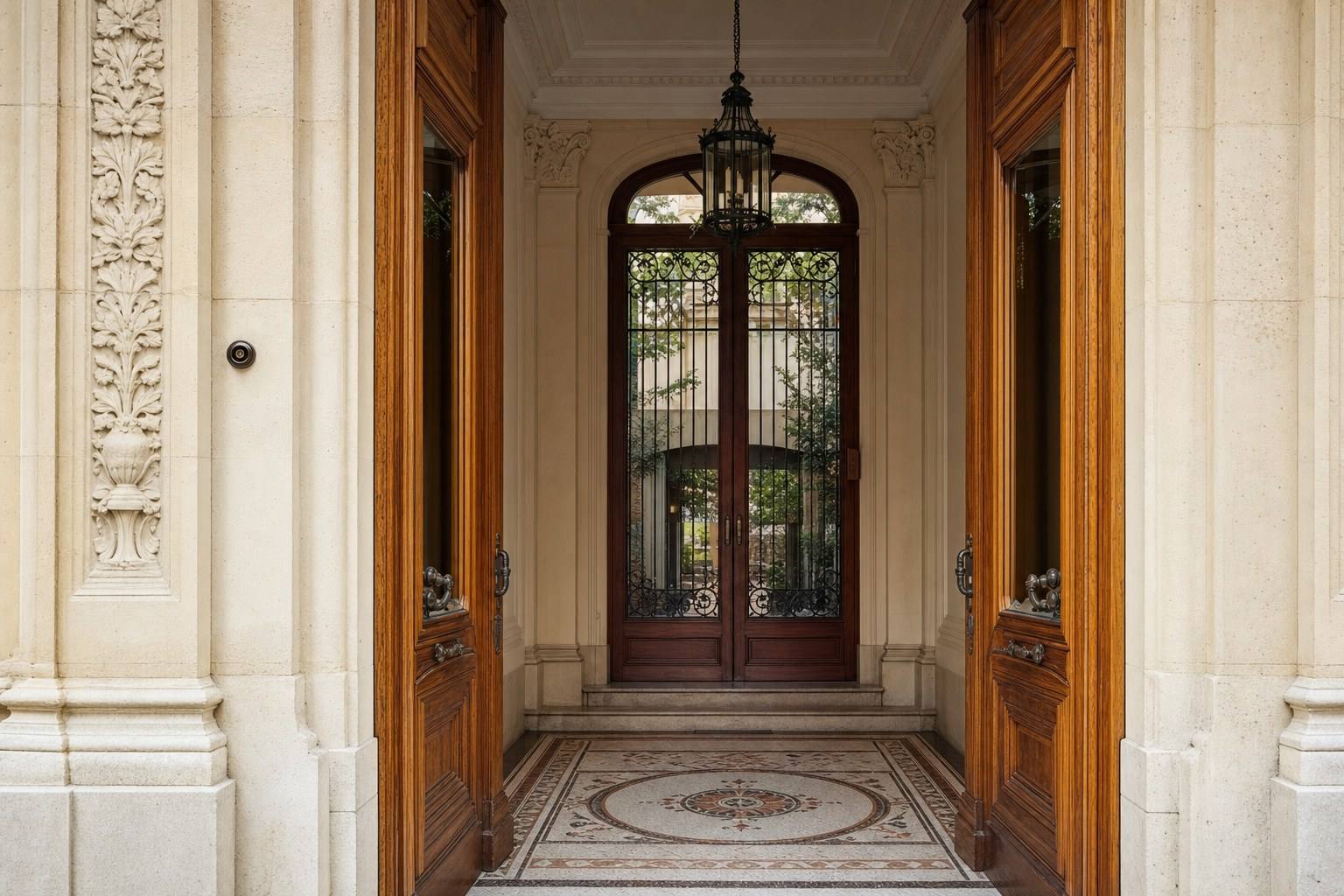
Standing before a Parisian building, a trained eye needs no notarial deed to guess its age. The ironwork of a balcony, the curve of a stair rail, the colour of an entrance tile or the design of a crémone all speak, wordlessly, of the exact period in which it was built. Each generation of builders left its signature in these details we pass every day without truly seeing, and once decoded, they turn a simple façade into a historical document.
Learning to read these clues is not merely a way to appear knowledgeable on a stroll. It means understanding a building’s structural logic, anticipating what lies hidden behind its walls, and appreciating the heritage value of the features that give it its charm. Here is a quick dating guide, clue by clue, to place any Parisian building on the timeline.
Façade and pierre de taille: the first reading
The façade is the most visible identity card. Even before you come close, its composition offers a range of dates.
Under the Ancien Régime and through the early nineteenth century, many Parisian buildings were built in rendered rubble stone, sometimes with concealed timber framing, with irregular façades and storeys of uneven height. Pierre de taille, the finely cut limestone used for prestigious construction, was costly and remained reserved for the finest buildings.
With the major works of the Second Empire, pierre de taille, the pale limestone known as “pierre de Paris”, became the standard on the boulevards. A haussmannien building can be recognised by its perfectly coursed façade, ordered according to a strict grammar: a noble floor emphasised by a balcony, cornices aligned from one building to the next, and a mansard roof in zinc.
A few façade markers:
- Rendered façade, irregular lines, uneven windows: often built before 1850.
- Sober pierre de taille, restrained ornamentation, balconies on the 2ᵉ and 5ᵉ floors: the height of the Second Empire, 1850-1870.
- Highly ornamented pierre de taille, bow windows, sculpture, deliberate asymmetry: Belle Époque, around the turn of the twentieth century, when the City relaxed its rules.
- Brick, exposed concrete, geometric lines or stylised curves: interwar period, 1920-1930.
Balcony ironwork: a calendar in wrought iron
No detail is more reliable than a balustrade. Ironwork follows fashion with such regularity that it becomes a calendar in its own right.
From the eighteenth century to the First Empire
Early balconies favour wrought iron worked by hand: generous curves, rocaille motifs in the eighteenth century, then more sober, symmetrical lines under the Empire, ornamented with palmettes or antique-inspired motifs. The metal is thick, each piece slightly irregular, the mark of forge work.
The haussmannien balcony
Under Haussmann, the balustrade became standardised. One finds straight vertical bars, often punctuated by a more elaborate central motif, all with great restraint. On the noble floors, the continuous balcony runs across the full width of the façade. This is the design most familiar in the Paris we photograph.
The Belle Époque and Art Nouveau
From the 1890s onward, ironwork broke free from the straight line. Motifs became botanical, undulating and asymmetrical: stems, flowers and the characteristic whiplash curves of Art Nouveau. A balcony with organic curves almost certainly points to a building from the turn of the century.
Les Années folles and Art Deco
In the 1920-1930, ironwork became geometric. Chevrons, stylised fans, circles and broken lines reveal Art Deco. Wrought iron sometimes gave way to more industrial iron, or to the artist-blacksmith working in highly recognisable graphic motifs.
Stairwell, lift and floors: the interior speaks
Once past the porte cochère, the entrance hall and stairwell bring together a wealth of clues, often better preserved than the façade, as they are less exposed.
Entrance tiling
The hall floor is a precious marker. Cement tiles with colourful geometric patterns spread from the second half of the nineteenth century and reached their peak around 1900. Mosaic, especially small cabochons and friezes, often points to the late nineteenth and early twentieth century. A checkerboard of tomettes or stone slabs suggests older or more modest buildings.
The railing and stairwell
- Elaborate wrought-iron railing, stone steps, stencilled painted wall: a nineteenth-century bourgeois building.
- Railing with Art Nouveau or Art Deco motifs, coloured stained glass: turn of the century or interwar period.
- Service staircase separate from the main staircase: typical of haussmannien and Belle Époque buildings, organised around social hierarchy.
The lift
The lift is an excellent tell. Buildings predating the 1870s were not designed with one: when a lift exists, it was added later, often slipped into the central void of the stairwell. An original lift, with its wooden cabin, wrought-iron landing doors and grilled shaft, generally places the building between the late nineteenth century and the interwar period, when it became a marker of status.
Joinery and crémones: the devil in the details
Windows and their mechanisms are more discreet, but just as eloquent for those who know where to look.
Before industrialisation, windows had small panes separated by thick glazing bars, large-format glass did not yet exist. Over the course of the nineteenth century, panes grew larger: a window with two or three large panes per casement indicates a later construction.
The crémone, the long vertical rod that locks a window in a single movement, is well worth a glance. Older models, in cast iron or brass, display ornate handles, olive-shaped or finely worked knobs. A visible, patinated mechanism, with its rods on show, belongs to an earlier period; a concealed, smooth closing system betrays recent or replaced joinery.
Inside, other details complete the dating:
- Pocket doors (sliding into the partition) and tall moulded doors: nineteenth-century bourgeois interiors.
- Brass hardware, antique bec-de-cane lever handles: preserved period fabric.
- Parquet point de Hongrie or herringbone parquet: a signature of the nineteenth and early twentieth century.
A short summary by period
To summarise, here are the dominant clues according to the major periods of Parisian construction. Treat them as a cluster of indicators: it is the convergence of several signs, not one isolated detail, that produces a reliable date.
| Period | Façade | Ironwork | Floors & stairwell | Joinery | |---|---|---|---|---| | Before 1850 | Render, uneven storeys | Curved wrought iron, rocaille | Tomettes, stone | Small panes, thick timber | | Second Empire (1850-1870) | Ordered pierre de taille | Straight bars, continuous balcony | Cement tiles | Larger panes, cast-iron crémone | | Belle Époque (1870-1914) | Ornamented stone, bow windows | Art Nouveau curves, botanical motifs | Mosaic, stained glass, original lift | Large panes, ornate brass | | Interwar period (1920-1939) | Brick, concrete, stylised lines | Geometric Art Deco motifs | Graphic floors, lift | Wide casements, pared-back fastenings |
In brief, To place a Parisian building in time, never rely on a single detail. Cross-check the façade, balcony ironwork, entrance tiling and the design of the crémones: when three clues agree, the dating becomes secure. Curved wrought iron and small panes signal an older building; straight bars and pierre de taille, the Second Empire; botanical curves, the Belle Époque; geometric motifs, Art Deco.
Knowing how to date a building is not simply an exercise in erudition. It is the first gesture of any respectful renovation: identifying what is original, what has value, and what deserves to be restored rather than replaced. A period crémone, a hall mosaic, balcony ironwork, all are witnesses that a well-led project knows how to preserve. This is the eye Lumiera brings to every Parisian apartment before touching a thing.
The next time you step through a Parisian porte cochère, take the time to read its details: they will tell you far more than its age.