
Renovating a Period Apartment Without Stripping Away Its Character: What to Preserve, What to Modernise
How to renovate a period apartment without losing its charm: what to preserve, what to modernise first, and the irreversible mistakes to avoid in Paris.
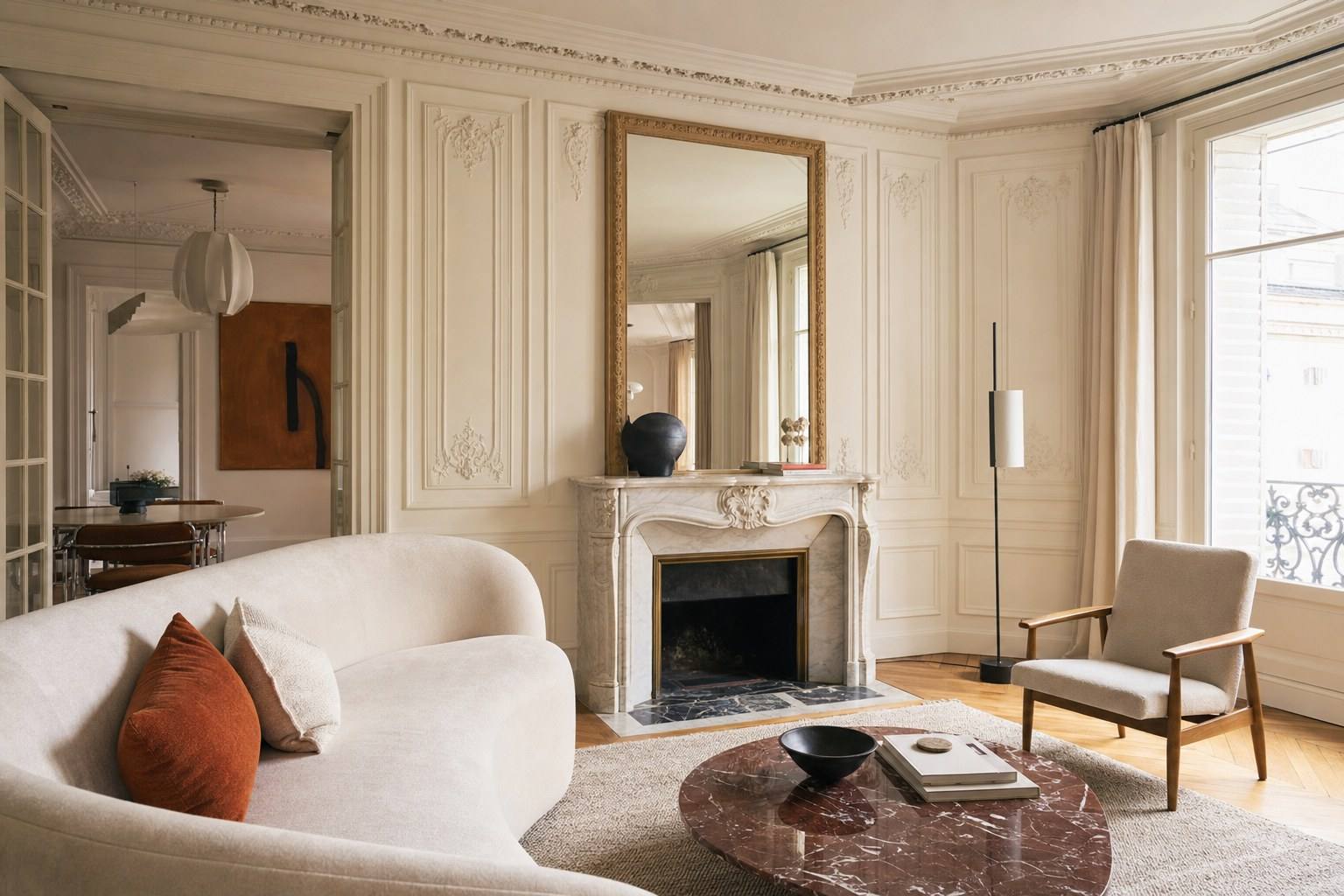
A period Paris apartment carries within it two centuries of ways of living: parquet floors that have seen generations pass through, hand-drawn mouldings, ceiling heights designed to capture the northern light. When renovating, the temptation is to start again from scratch. It is often the costliest mistake, and the most irreversible. Because what gives a period property its value cannot simply be bought back by the square metre.
And yet there is a simple rule, proven by the finest craftspeople and architects alike: modernise what is invisible, elevate what is historic. In other words, replace without hesitation everything you do not see, services, insulation, thermal comfort, and carefully protect everything that gives the place its character. Follow this principle and you ensure an apartment that is healthy, high-performing and true to itself. Here is how to apply it, room by room, decision by decision.
In brief
- Preserve: original parquet, mouldings, fireplaces, panelled doors, ironwork, ceiling height.
- Modernise first (the invisible): electrics, plumbing, insulation, heating, joinery.
- Bring together period and contemporary through controlled contrast, never imitation.
- Avoid the irreversible: tearing out original parquet, burying mouldings, demolishing a load-bearing wall without a structural study.
- When in doubt, an interior architect can determine what should be preserved and what can be transformed.
Taking Stock of Character Features: What to Preserve
Before a single hammer blow, you need to understand what you have. The first instinct in a respectful renovation is not to demolish, but to take inventory. Walk through the property, room by room, noting everything that belongs to the original architectural fabric.
Features Almost Always Worth Preserving
- Original parquet: solid oak in parquet point de Hongrie or herringbone, it can be sanded, repaired and refinished endlessly. Period parquet in good condition is a major heritage asset, impossible to replace identically.
- Mouldings and cornices: they frame the eye and reveal the era. Clean them, restore them, and reinstate missing sections in staff plaster rather than flattening them away.
- Fireplaces: even when no longer in use, they remain powerful focal points. The overmantel and the marble or stone surround deserve to be preserved.
- Interior joinery: moulded panel doors, brass cremone bolts, high skirting boards. Replacing them with standard fittings instantly impoverishes a room.
- Ceiling height: it is not seen as an object, yet it shapes everything. Continuous dropped ceilings that crush the proportions should be avoided at all costs.
Features to Assess Case by Case
Some elements require judgement. Parquet that is too damaged, affected by damp or dotted with mismatched repairs may justify partial removal. Entrance encaustic cement tiles, an atelier-style glass partition, old tomettes: depending on their condition and authenticity, they can be restored or reinterpreted. The question is always the same: is this element original, repairable, and meaningful? If so, keep it.
Priority “Invisible” Modernisations
This is where most of the budget of a serious renovation goes, and it is also what no one will notice once the work is complete. So much the better: the performance of a period apartment is determined behind the walls.
Electrics and Plumbing
An outdated electrical installation is the first item to be fully replaced: earthing, a compliant consumer unit, and a sufficient number of circuits. On the plumbing side, old lead or galvanised steel pipes should be removed in favour of copper or multilayer piping. These updates often mean reopening chases, the opportunity to do everything properly, once and for all.
Insulation and Thermal Comfort
A haussmannien apartment can be magnificent and energy-hungry. The challenge is to gain comfort without stripping away its character.
- Windows and joinery: replace windows with double glazing while respecting the original proportions and glazing bars, or opt for like-for-like refurbishment on protected façades.
- Internal insulation: on street-facing or courtyard-facing walls, carefully designed lining can significantly improve comfort, provided mouldings and reveal depths are preserved.
- Heating: move from old convectors to a more efficient system while, where possible, keeping period cast-iron radiators, which are beautiful and remarkably effective.
Energy improvement offers a double benefit: it makes the property more pleasant to live in and enhances its long-term value, without taking anything away from its soul.
A Successful Marriage of Period and Contemporary
A successful renovation is not a museum. Period architecture comes alive all the more when it is in dialogue with the present. But two equal pitfalls must be avoided: pastiche, which imitates the past to the point of fakery, and a blank slate, which erases it altogether. The right path is one of controlled contrast.
Principles That Work
- Contrast rather than imitation: a resolutely contemporary kitchen, with clean lines, sets off original parquet far better than furniture pretending to be period.
- Restraint in new interventions: honest materials (brass, pale oak, natural stone, slender glass partitions), a calm palette, carefully resolved details. New work should read as new, with confidence.
- Light as the guiding thread: discreet contemporary lighting reveals mouldings and the depth of rooms without freezing them in time.
- Respect for volumes: open up spaces judiciously, while preserving the enfilade and sightlines that give the original plan its charm.
The aim is not to choose between old and modern, but to let them speak to one another. A well-renovated apartment tells the story of both eras in a single breath.
Irreversible Mistakes to Avoid
Some decisions cannot be undone. Taken lightly, they are the ones that diminish a property’s value for the long term.
- Tearing out original parquet to install a standard floor: you destroy a heritage element that nothing will replace identically.
- Burying or flattening mouldings under plaster or a dropped ceiling: the room’s character can disappear in a single day on site.
- Removing fireplaces to “gain space”: you sacrifice an irreplaceable focal point for a few centimetres.
- Demolishing a load-bearing wall without a structural study: beyond the major technical risk, it is a mistake that affects safety and liability within the copropriété.
- Replacing all joinery with standard products: generic doors, cremone bolts and windows erase the identity of the place.
- Over-partitioning to multiply rooms: you cut into the volumes and the light, the two true luxuries of period architecture.
The golden rule can be summed up in one sentence: in a period property, anything demolished quickly takes decades to recreate, if it can be recreated at all. The charm of the old is capital that haste can erode beyond return.
When to Bring in an Interior Architect
Renovating a period apartment without distorting it means making constant judgements between preservation and transformation. This is precisely where an interior architect brings decisive value.
Their role: to diagnose what should be retained, design a project that reconciles contemporary comfort with respect for the existing building, and anticipate sensitive issues, structure, services, copropriété, permissions. Bringing one in becomes particularly relevant when:
- the project affects the layout of the rooms or a load-bearing wall;
- the property contains strong heritage features that must be restored without betraying them;
- you want to reconcile energy performance with the original aesthetic;
- you would like a single point of contact to design, coordinate and ensure the coherence of the whole.
It is this approach, both technical and sensitive, that distinguishes a simple refurbishment from a true renovation. At Lumiera, every period apartment is approached with this commitment to preservation: modernising everything that needs to be, protecting everything that gives it value, and restoring an elegance that transcends eras.
Do you own a period apartment in Paris and want to renovate it without losing its soul? Let’s discuss your project: together, we will define its perfect measure.