
Soundproofing in Paris: Restoring Calm to Period Apartments
Neighbour noise, creaking parquet, busy streets: how to soundproof an old Paris apartment without compromising parquet or mouldings. 2026 solutions and budgets.
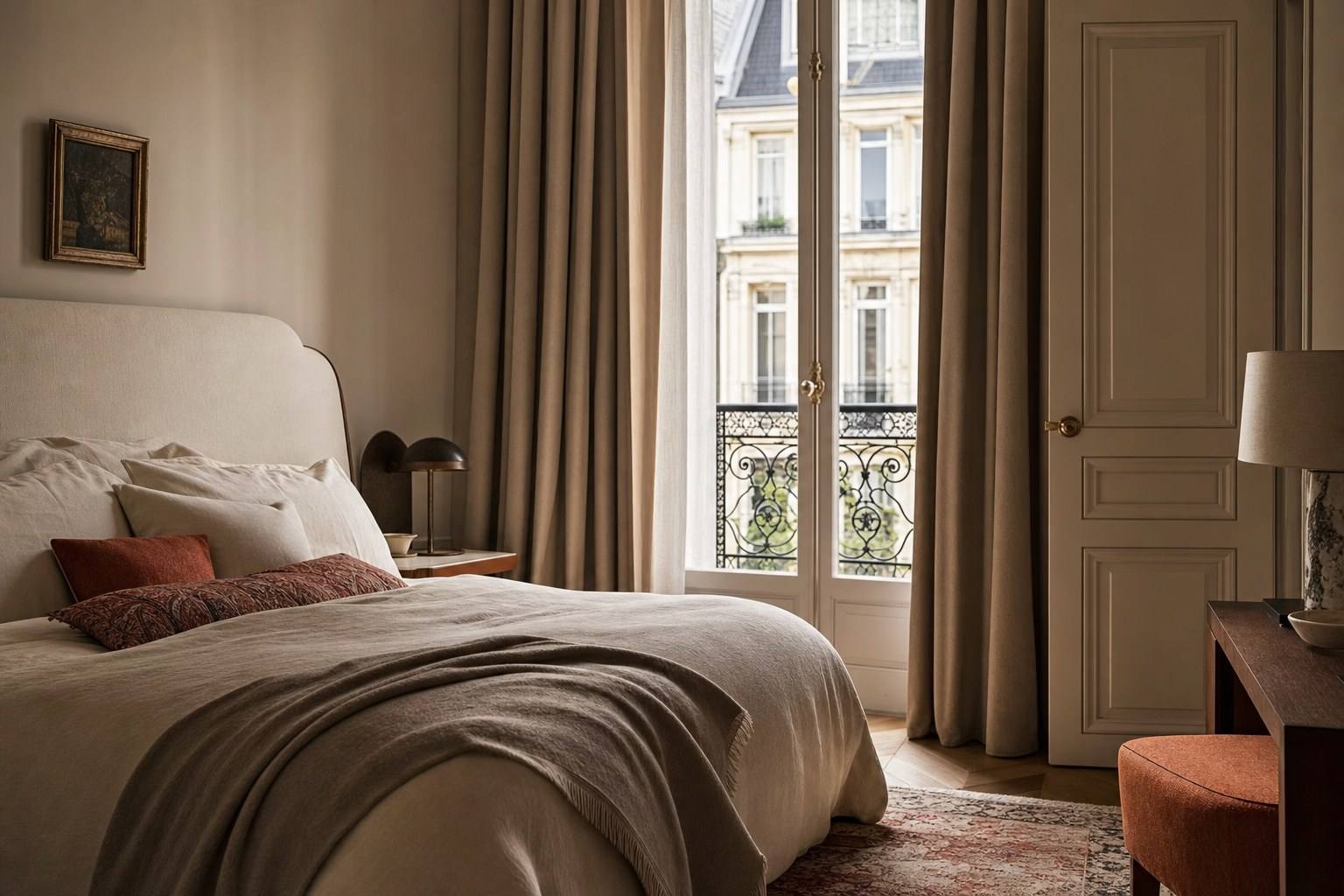
In Paris, silence is a luxury. In a period building, partitions are thin, timber floors transmit every footstep, and street noise slips in through original windows. The neighbour upstairs walking across the room, a conversation carrying through the party wall, creaking parquet, traffic below: these nuisances are part of everyday Parisian life, and they can seriously undermine the comfort of an otherwise beautiful home.
The good news is that sound can be addressed without stripping everything out. Soundproofing a period property does not mean sacrificing parquet point de Hongrie, nor hiding mouldings or fireplaces. The key is first to understand where the noise is coming from, because each type of nuisance calls for a different response. Here is how to approach it, element by element, to restore calm at home.
In brief
- Airborne noise voices, television, street noise travels mainly through walls, windows and gaps in airtightness.
- Impact noise footsteps, knocks, parquet is transmitted through the structure: it must be treated at floor level, at the source.
- A single well-treated window can dramatically reduce perceived street noise.
- It is possible to insulate without compromising parquet, mouldings or ceiling height, provided the project is designed upstream.
- Indicative 2026 budget: from a few hundred euros for a targeted intervention to several thousand for comprehensive treatment of a room.
Where noise comes from in period buildings
Before choosing any solution, the first step is to identify the enemy. There are two main families of noise, and they behave very differently.
Airborne noise travels through the air: a conversation, music, the horn of a scooter. It passes through the weakest surfaces, a lightweight partition, a poorly sealed door, single glazing, and slips through the smallest gap.
Impact noise, or structure-borne noise, is created by an impact on the structure itself: heels on the parquet above, a chair being dragged, a door slamming. It travels from one element to the next through floors, walls and beams. It is the most insidious type, because it can easily bypass insulation designed only to block airborne sound.
In a haussmannien or faubourg building, several weak points often coexist:
- timber floors laid on joists, excellent conductors of vibration;
- old partitions, sometimes lightweight plaster on lath, brick slips that do little to filter voices;
- original windows with single glazing, the main entry point for street noise;
- flanking paths: service ducts, chimney flues, gaps under doors, through-wall electrical sockets.
Understanding this map avoids the most costly mistake: treating a wall when the noise was in fact coming through the floor or the window.
Floors, walls and ceilings: the solutions
Each surface requires its own strategy. The aim is always the same: to decouple and absorb, rather than simply add thickness.
The floor, the top priority against impact noise
The floor is often the weakest link. Two approaches can be combined:
- A resilient underlay beneath the future floor finish, whether parquet or tiles, absorbs impacts at the source. This is the most effective measure against footsteps and moving furniture, with only minimal additional thickness.
- A floating screed or decoupled floor, where the available height allows, cuts the transmission of vibration into the structure. It performs better, but requires more build-up.
Worth noting: you can only control the noise you transmit to the neighbour below. For footsteps coming from above, the only action you can take from your own apartment is at ceiling level.
Party walls
For voices passing through a shared wall, the benchmark solution is a decoupled lining wall: a frame independent of the original wall, filled with absorbent insulation and closed with one or two boards. The trapped air and mechanical break form a barrier. Expect to lose a few centimetres from the room, a trade-off that must be carefully weighed when every Parisian square metre is valuable.
Ceilings
To reduce noise from the floor above, an acoustic suspended ceiling on anti-vibration hangers, with integrated insulation, can deliver real improvement. The point to watch in period properties is ceiling height: the generosity of the volumes and the line of the cornices must be preserved.
Windows and street noise
On a busy street, the window is usually the main culprit, and often offers the best results for the investment. Several options exist, depending on the property and on the rules of the co-ownership or protected area.
- Asymmetrical double glazing: two panes of different thicknesses break resonance and are particularly effective on traffic frequencies.
- Secondary glazing: an additional pane fitted to the existing window, a lighter-touch solution that preserves the original joinery.
- A double window: a second window fitted within the reveal, creating a highly effective air gap. Excellent performance, but more complex to install.
The principle is simple: even the highest-performing window is useless if air passes around it. Replacing or renewing airtight seals and treating the roller shutter box, a frequent weak point, often delivers as much benefit as the glazing itself.
Compatibility with parquet and mouldings
This is the legitimate concern of anyone who owns a beautiful period apartment: does soundproofing mean erasing its character? No, provided acoustics are integrated from the design stage, rather than added as an afterthought.
A few principles help preserve the heritage fabric:
- Beneath the parquet, the resilient underlay is invisible once installation is complete. An old parquet floor can be carefully lifted and relaid on an improved substrate, or replaced like for like.
- Mouldings and cornices can be worked around: an acoustic ceiling can stop short of the cornice, or the cornice can be reinstated around the perimeter to preserve the reading of the volume.
- Stone or marble fireplaces are preserved; it is the flue, an unwanted acoustic pathway, that is treated discreetly.
- Ceiling height is managed room by room: reinforcement is applied where noise is genuinely intrusive, without weighing down the entire apartment.
The entire challenge lies in reconciling acoustic performance with respect for what is already there. This is precisely the terrain of a renovation conceived as a whole: at Lumiera, soundproofing is designed at the same time as the layout, services and restoration of original features, so that comfort is never gained at the expense of character.
Budget and realistic gains
It is impossible to give a single price: everything depends on the area treated, the nature of the noise and the level of performance required. That said, the main orders of magnitude can be framed.
- A targeted intervention renewing seals, treating a shutter box, adding secondary glazing to one window: from a few hundred to a little over a thousand euros per point.
- Acoustic treatment of a wall or ceiling in one room: generally several thousand euros, including materials and installation.
- Replacement with high-performance windows in rooms facing the street: a significant item, but one that also improves thermal comfort and the value of the property.
(Indicative 2026 ranges, to be confirmed without fail by a survey and detailed quotation.)
As for results, a few honest benchmarks are better than a promise of total silence:
- Noise is not eliminated; it is reduced. The objective is to bring it back below the threshold of disturbance.
- The best return on investment almost always comes from the floor for impact noise, and from the window for street noise.
- Treating only one element while ignoring the others leads to disappointment: sound follows the weakest path. Prioritising correctly is the key to a well-spent budget.
Restoring calm without sacrificing character
Soundproofing a period apartment is not about piling on materials: it is about understanding exactly where each noise travels, then responding precisely, while preserving what gives the place its soul. A careful survey beforehand prevents money being spent in the wrong place, and avoids unnecessary damage to parquet or a cornice that could have been retained.
This is the logic of an integrated renovation, where acoustic comfort is considered alongside light, volumes and heritage. At Lumiera, every Parisian project reconciles performance with respect for period fabric, so that restored silence sits naturally with preserved character.
Is noise spoiling your apartment? Let’s talk: we will prepare an acoustic diagnosis and a bespoke action plan, room by room.