
The Colour of Paris Façades: A History of Stone, Ravalement and Tints
Why Paris is beige-blond: pierre de taille, mandatory ravalement and regulated colour charts give the capital its instantly recognisable hue.
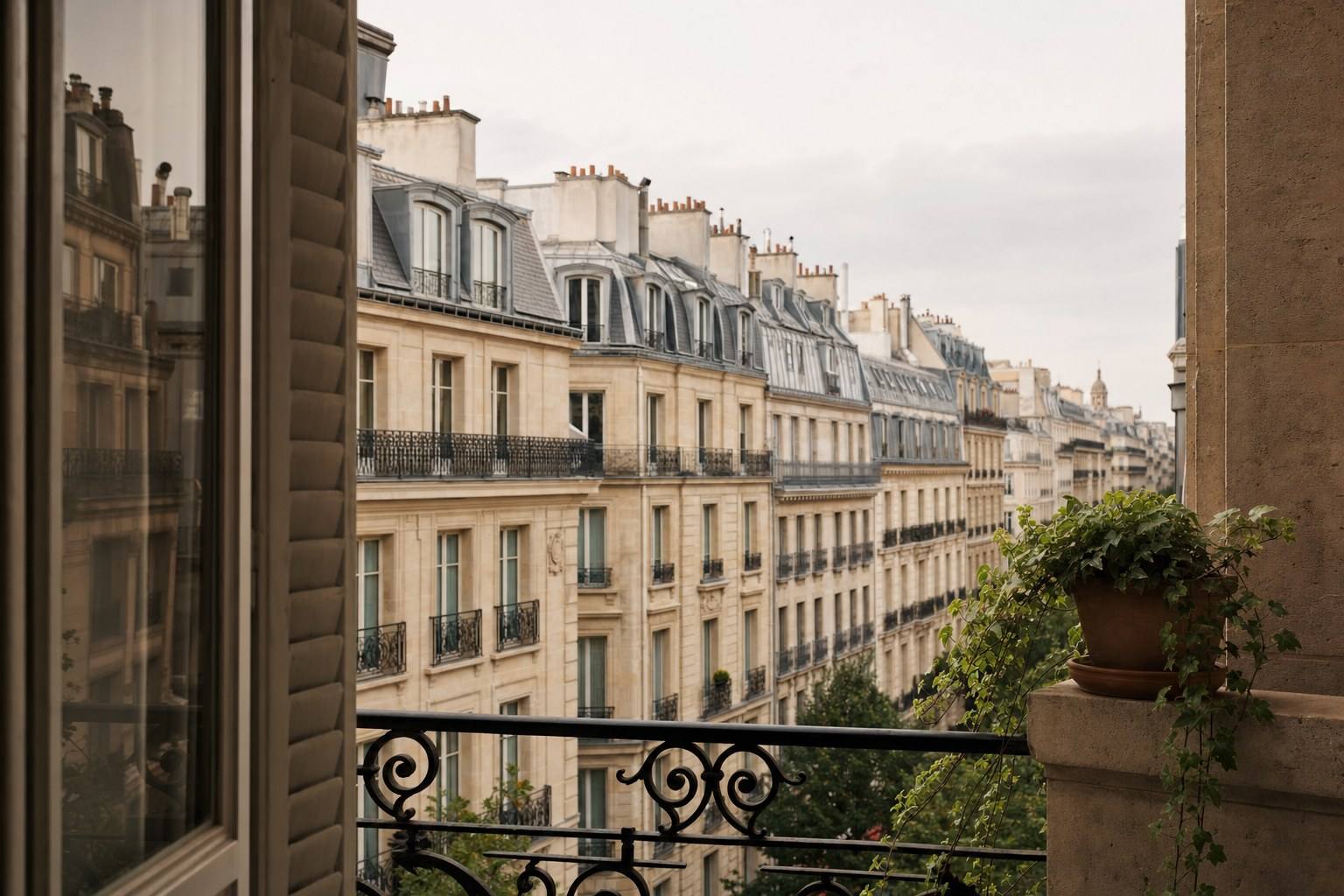
There is a colour of Paris. Not quite white, not truly yellow: a luminous beige-blond that catches fire in the late-afternoon sun and veils itself in grey when it rains. We barely notice it, so natural does it seem, and yet there is nothing accidental about it. This singular hue, running from one boulevard to the next without ever breaking, is the product of a material, the pierre de taille (finely cut building stone) quarried from beneath the city itself, and of a persistent rule: the obligation, for every owner, to periodically revive their façade.
To understand this colour is to trace two intertwined histories. The first is that of a soft, blond, porous limestone that built Paris before giving it its face. The second is that of an old regulatory principle, ravalement (façade restoration), which requires the capital to wash its brow at regular intervals. For anyone who owns an apartment in Paris, this is no abstract matter: the façade is a shared asset, regulated and sometimes overseen by the Bâtiments de France, and what it says to the street already reveals a great deal about the interior it protects.
The limestone of Paris and its palette
Paris is a city of limestone. Beneath its streets lies a bed of sedimentary rock deposited tens of millions of years ago, when a warm sea covered the Paris Basin. This stone, first extracted in the very heart of the capital, from quarries that hollowed out the subsoil of the Left Bank and the outskirts, was used to raise apartment buildings, churches and monuments.
The most famous of these rocks is a soft, pale limestone, easy to cut when it comes out of the ground and slowly hardening on contact with the air. Its natural colour ranges from cream to gentle blond and a lightly gilded beige. It sets the tone. Haussmannien façades, cut from this material, therefore share the same chromatic foundation: not an applied paint, but the stone’s own colour.
This palette is not perfectly uniform. It varies according to several factors:
- the quarry bed: depending on depth and quarry, the stone leans more or less towards white, ochre or grey;
- exposure: a south-facing façade, long caressed by the light, does not age like a courtyard façade, in shade and humidity;
- time and pollution: over the decades, dust and particles lay down a dark veil that gradually dims the stone.
It is precisely because the stone becomes soiled that the question of its maintenance arose very early on. A city of pale limestone is a city that darkens, unless it is required to come back to life.
Mandatory ravalement: origin and rule
The idea that an owner must maintain the face of their building is long established in Paris. Well before the grands travaux of the XIXᵉ century, the public authorities were concerned with the cleanliness and healthfulness of the façades lining the public street. The principle is simple and can be summed up in one sentence: a façade belongs not only to its owner, but also to the gaze of the street.
From this conviction came an obligation. Ravalement, the operation of cleaning, repairing and restoring the exterior facing of a building, has long been periodically mandatory in the capital. The spirit of the rule has remained constant through the ages: a building whose façade is deteriorating or dirty must be restored, and the owner cannot avoid that responsibility indefinitely.
What ravalement involves in practice
Ravalement is often reduced to simple cleaning. In reality, it is a more comprehensive intervention, which may include:
- cleaning the stone, using gentle techniques suited to soft limestone, to remove the veil of pollution without damaging the material;
- repairing damaged areas: repointing, replacing stones that are too deteriorated, and addressing cracks;
- restoring decorative elements: cornices, mouldings, balconies, ironwork and guardrails;
- restoring renders on façades that are not exposed stone, with the selection of a compliant colour.
The aim is never purely aesthetic. A well-executed ravalement also protects the building fabric: it prevents water infiltration, preserves sound stone and extends the life of the façade. Restored beauty is, in a sense, the visible consequence of good maintenance.
Regulated colour charts and the Bâtiments de France
If Paris retains its unity of colour, it is also because one does not restore a façade in any shade one likes. The city is not an open colour chart. For pierre de taille façades, the rule is clear: the stone is not painted. It is cleaned, repaired and returned to its natural colour, but it is not covered with a coloured layer that would betray the material.
For rendered façades, however, the choice of colour is regulated. Planning documents and local recommendations guide owners towards a range of tones consistent with the surroundings: beiges, stone shades and muted hues that extend the city’s mineral palette rather than contradict it. The guiding idea is always the same, to preserve the harmony of the street and avoid any jarring break.
The role of the Bâtiments de France
This requirement becomes stricter in the most heritage-sensitive areas. Around historic monuments and within protected perimeters, projects affecting the exterior appearance of a building are reviewed by the Architecte des Bâtiments de France. Their assessment concerns what can be seen from public space: the chosen colour, the nature of the materials, the treatment of joinery and the coherence of the whole.
In practical terms, this means that the choice of a façade colour in these zones is not a private decision. It forms part of a continuity and must be approved. It is this patient vigilance, building by building, that explains how an entire boulevard can move through the decades without ever losing its unity.
Façade and co-ownership: who decides, who pays
One very practical question remains for any Parisian owner: when ravalement is required, who decides and who pays the bill? In the vast majority of the capital’s buildings, the façade belongs to no one in particular. It is a common area of the co-ownership.
That changes everything. A co-owner cannot, alone, decide to restore the building’s façade or choose its colour. The decision is made collectively, at the general meeting, and the cost is shared by all according to the rules of the co-ownership. The usual process follows a few steps:
- a survey of the façade’s condition, often entrusted to a professional, establishes the necessity and scope of the works;
- the syndic places the matter on the agenda and obtains quotations;
- the general meeting votes on the works, the selected contractor and the financing;
- the cost is divided among the co-owners, generally in proportion to their tantièmes.
In brief In Paris, the façade is almost always a common area. Ravalement is voted on at the general meeting, managed through the syndic, and paid for collectively according to tantièmes. An individual owner rarely bears the works schedule alone, they share it.
A word on cost, because it always comes up: the price of ravalement depends on the surface area, the condition of the stone, the richness of the decoration and the scaffolding required. It varies significantly from one building to another and cannot be reduced to a single figure. Depending on the configuration, the expense runs from tens to several hundreds of euros per square metre of façade (indicative 2026), and must always be confirmed by quotations prepared on site.
What the façade says about the interior
Finally, there is a more discreet, almost intimate reading of façade colour. Beautifully cleaned stone, carefully tended joints, well-maintained ironwork: all of this signals a building that is looked after, a co-ownership attentive to its heritage. The façade is the first room one visits, even before crossing the threshold.
And that continuity carries on inside. The blond limestone that gives the street its colour is echoed in the cream tones of the walls, the warmth of an old parquet floor and the soft light reflected by high ceilings. To restore a Haussmannien apartment with precision is to extend inward the spirit the façade displays outside: a mineral, understated elegance that lets light do its work. This coherence between envelope and interior, this way of bringing the stone of the city into dialogue with the comforts of today, is precisely what guides every project undertaken by Lumiera.
Because a façade does not lie. It announces the colour, quite literally, of what is taking place behind it.
Renovating an apartment in an old Parisian building? Let’s talk about how its character, from stone to parquet, can regain its full radiance.