
The Parisian Marble Fireplace: History, Styles and Restoration
The history of the Parisian marble fireplace, from Louis-Philippe to Belle Époque styles, and how to restore or showcase it in a period apartment.
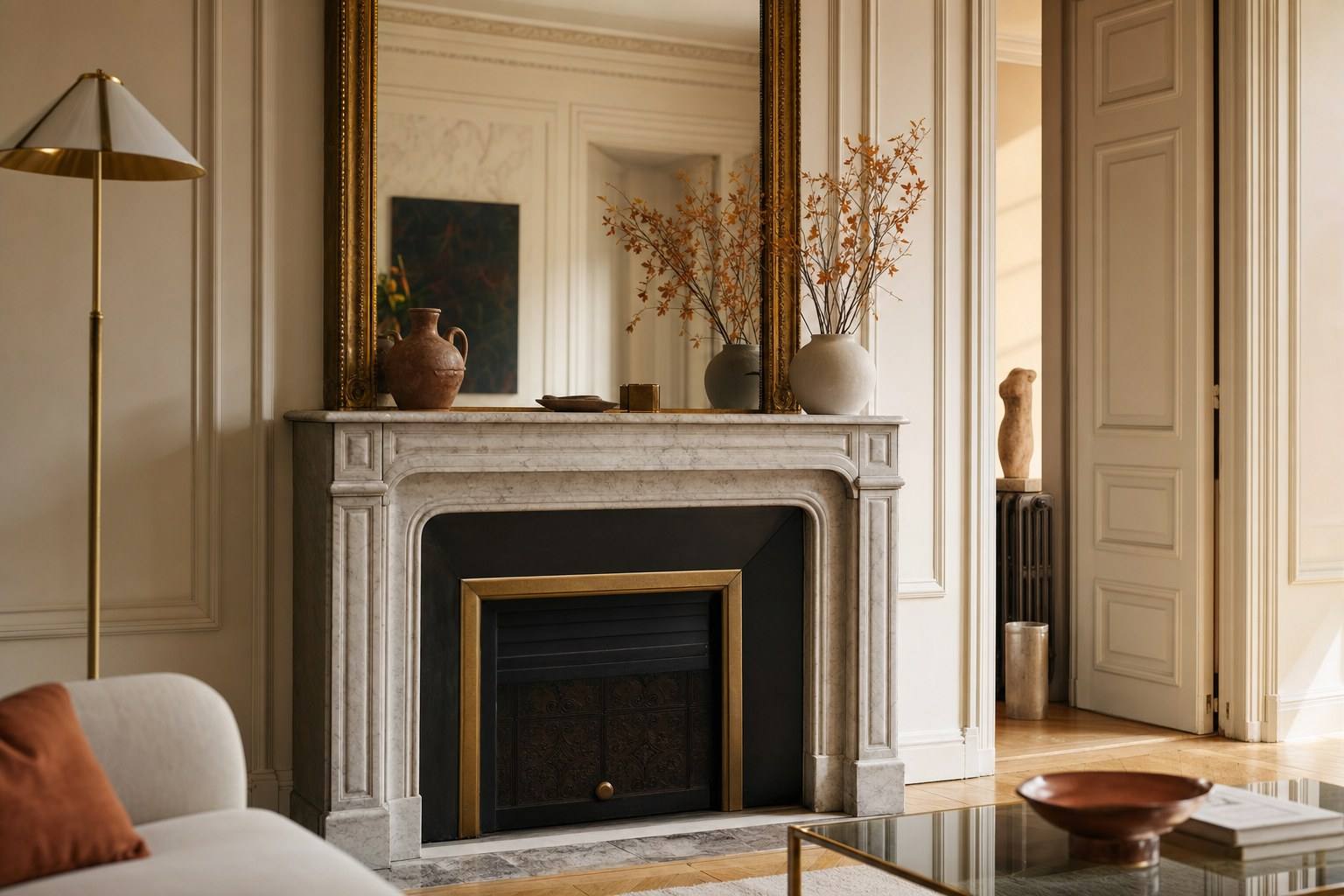
In a period Parisian apartment, the marble fireplace is often the first thing the eye seeks out. It structures the living room, anchors the space, and speaks of another era. We tend to think of it as decorative, almost incidental; in reality, it is a document. Its line, the colour of its stone, the design of its lintel all allow those who know how to read them to date a room to within a few decades.
A fireplace can indeed be read as a dated object. A heavy, restrained shelf and solid, slightly curved jambs evoke the reign of Louis-Philippe; more generous curves, dark veined marble point to the Second Empire of Napoléon III; a tauter elegance, sometimes touched with floral motifs, belongs to the Belle Époque. To understand this grammar is to stop seeing a simple ornament and recognise a fragment of history, and then decide, with clarity, whether to preserve it, restore it or reinvent it.
The role and evolution of the fireplace in the Parisian apartment
For a long time, the fireplace was not a decorative object: it was the home’s only source of heat. Before central heating became widespread, every main room, living room, dining room, bedrooms, had its own. This is why several fireplaces can still be found in many apartments today, set against party walls and connected to flues that rise up to the roof.
This vital function explains its central place in the composition of a room. Armchairs were arranged around it, a mirror hung above it, a clock placed on the mantel: the fireplace was the social heart of the home, both literally and figuratively. Over the course of the XIXᵉ century, marble also established itself as the prestige material par excellence. Nobler than ordinary stone, more durable than wood, it conveyed the owner’s status, and grand bourgeois apartments competed through fine pieces selected from marbles sometimes sourced from far afield.
Then came the break. The arrival of central heating, at the end of the century and especially in the XXᵉ, deprived the fireplace of its original purpose. Many flues were sealed, and some fireplaces were dismantled. Those that survived changed status: from technical element, they became heritage object. It is this shift that gives them their value today.
Recognising styles and marbles
Dating a fireplace means bringing together two readings: that of the form and that of the material.
Reading the form
Each period imposed its own vocabulary, even though transitions were gradual and influences numerous.
- Louis-Philippe style (1830s-1850s): this is the most common model in old Parisian apartments. A sober, robust silhouette, a rectangular shelf with often rounded corners, full and slightly curved jambs. The overall effect is substantial, without ornamental excess. Its very simplicity made it a standard reproduced for decades.
- Napoléon III / Second Empire style (1850-1870): the spirit becomes richer. The lines soften, the lintel curves, mouldings appear. It reflects the period’s taste for abundance and decoration.
- Belle Époque and fin de siècle: the line becomes more refined, sometimes more intricate, with botanical motifs heralding Art nouveau. The design seeks elegance more than mass.
Reading the marble
The stone itself says a great deal. Without claiming specialist expertise, several families recur regularly in Parisian interiors:
- white marbles veined with grey, restrained and luminous, often associated with the most classical rooms;
- black marbles or very dark marbles, dense and theatrical, prized under the Second Empire;
- coloured, strongly veined marbles, red, brown, yellow and bluish-grey tones, which brought warmth and richness to bourgeois salons.
A useful clue: true marble is cold to the touch, heavy, and displays irregular veins that run through the mass. Some old fireplaces, however, imitate marble using a decorative painting technique known as ‘faux marble’, a craft in its own right, and one that also has value.
Sealed, decorative or functional?
This is the question that arises as soon as one inherits an old fireplace. Three situations, three decisions.
The sealed fireplace. In the majority of Parisian apartments, the flue was blocked when central heating was installed. The fireplace no longer draws, but its marble surround remains. This is the most common case, and there is nothing regrettable about it: the piece retains all its decorative and heritage interest.
The decorative fireplace. One then chooses, deliberately, not to reinstate a fire. The hearth becomes a space to be staged: purely aesthetic log storage, a display of objects, lighting, greenery. This is often the simplest and most elegant solution in a copropriété (co-owned building), where bringing a flue back into service can prove complex.
The functional fireplace. Reinstating a wood fire in a Parisian apartment is possible, but rarely straightforward: the flue must be in good condition, lined to current standards, ventilation must be sufficient and, almost always, the copropriété’s approval is required. Local regulations also govern the use of open hearths for air-quality reasons. Before undertaking any project, an assessment by a qualified professional is essential, it is a matter of safety as much as feasibility.
In brief In the overwhelming majority of cases, an old Parisian fireplace is preserved for its marble, not for its fire. Reinstating a working hearth remains possible, but requires a sound flue, lining to current standards and the approval of the copropriété.
Cleaning, restoration and safety
Marble is a noble stone, but it is also living and porous. Over time, it yellows, stains and chips along the edges. The good news: an old fireplace can almost always be restored; it is very rare for it to need replacing.
Cleaning without damage
The first instinct is also the most important: gentleness. Marble is vulnerable to acidity. Vinegar, lemon juice, descaling products and aggressive cleaners attack the stone and dull it permanently. Routine care should be carried out with warm water, a mild soap and a non-abrasive cloth.
For ingrained stains or yellowing, it is better not to improvise: certain interventions require the expertise of a marble specialist, who will know how to sand, whiten or repolish without hollowing the surface.
Repairing and reviving
The most common issues have tried-and-tested solutions:
- chips and broken edges: re-bonding and filling with colour-matched mastics, adjusted to the tone of the stone;
- cracks: consolidation by a professional, to be distinguished from a simple surface hairline;
- loss of shine: repolishing, which restores the marble’s original depth;
- protection: application of an appropriate treatment that limits stain absorption without freezing the stone’s natural appearance.
Safety above all
If functional use is being considered, no aesthetic restoration can replace a technical inspection. Chimney sweeping, checking the flue’s watertightness and integrity, lining, ventilation control: these steps must be handled by certified professionals. A beautiful but poorly maintained fireplace is not a safe fireplace.
Staging it today
Once restored, a marble fireplace is not a relic: it is an anchor point for contemporary decoration. The art lies in respecting it without turning it into a museum piece.
Playing with contrast. An old fireplace converses beautifully with a modern interior. A dark Second Empire marble responds to clean lines; a white Louis-Philippe piece works with a soft, graphic palette. It is this friction between periods that creates the most beautiful Parisian living rooms.
Dressing the mantel. Above it, the original large mirror remains a timeless choice; one might instead choose a contemporary artwork, a bold frame, or leave the wall bare to emphasise the stone. The shelf should hold a few carefully chosen objects rather than a crowded line-up.
Treating the hearth and lighting it. Even when sealed, the hearth can be staged: decorative logs, a stack of books, candles, a botanical arrangement, the essential thing is to avoid an empty void, which creates an impression of abandonment. Finally, grazing light reveals the veining of the marble and the relief of the mouldings. Properly lit, a fireplace becomes once again what it has always been: the room’s centre of gravity.
Restoring a Parisian fireplace is ultimately a matter of balancing history and use: knowing what deserves to be preserved, what can be revived, and what should be adapted to today’s comfort. This balance between respect for heritage and contemporary living lies at the heart of every renovation carried out by Lumiera, where the old is never an obstacle, but a material to be reinvented.
Do you own an old marble fireplace and wonder what to do next? Let’s talk about the best way to restore its rightful place in your interior.