
Buying and Renovating an Apartment in Paris: A Step-by-Step Guide for International Buyers
A practical roadmap for international buyers who want to purchase and renovate a Paris apartment: from choosing the right building to budgeting works and managing the project remotely.
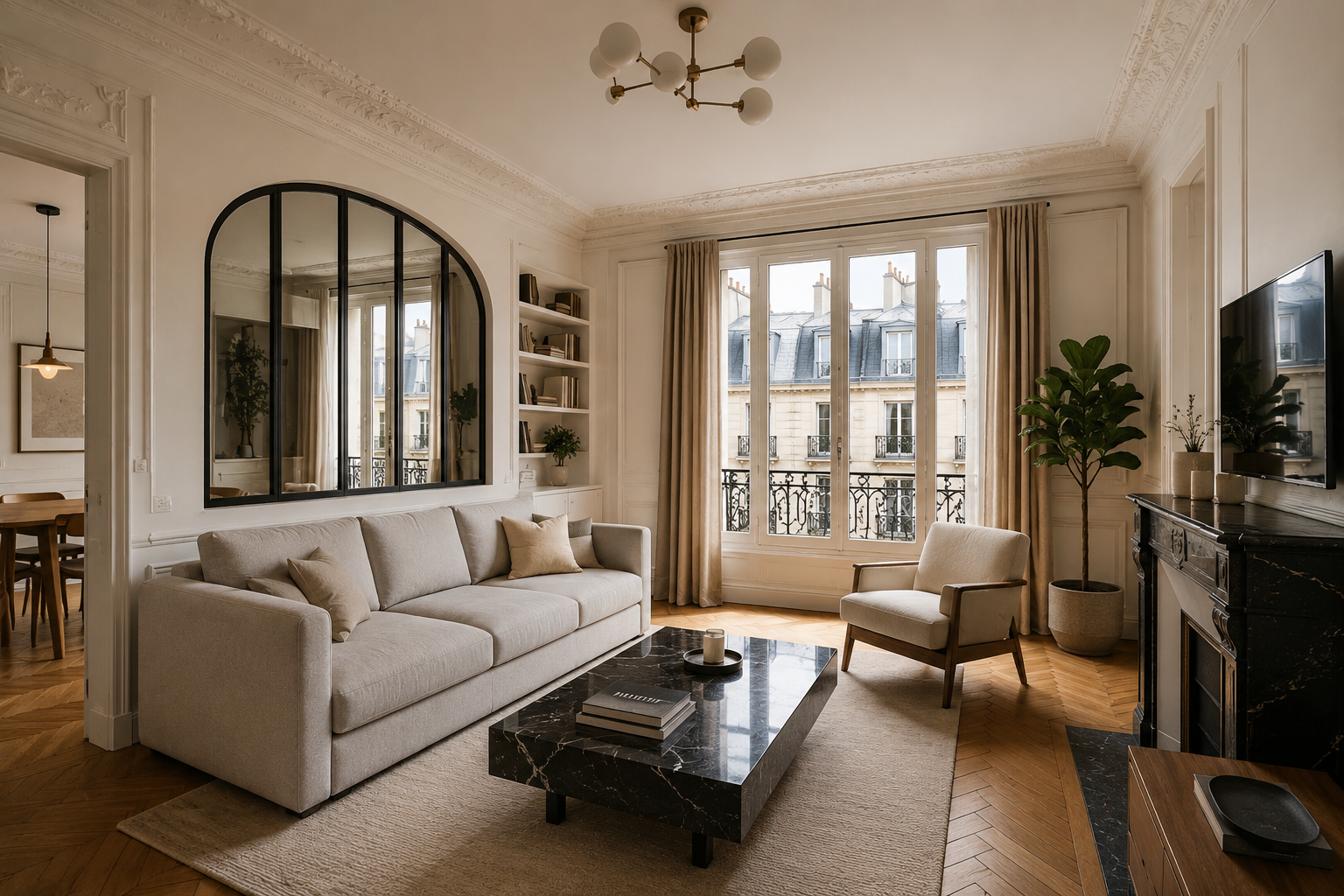
For international buyers, buying and renovating an apartment in Paris is often the smartest way to secure a home that is genuinely yours rather than settling for someone else's compromises. The Paris market rewards those who can see past dated kitchens, poor layouts and tired finishes, but only if the purchase and the renovation are planned together, as a single project, from the very first viewing. This guide walks you through how to do exactly that, especially when you are managing the process from another country.
Why buyers pair purchase with renovation in Paris
Paris has a limited stock of turnkey, move-in-ready apartments, and those that exist command a premium. Meanwhile, a large share of the market consists of period apartments (haussmannien, faubourien, post-war) that are structurally sound but stylistically and energetically outdated. Buying one of these and renovating it lets you:
Buy at a lower price per square metre and invest the difference in works you control.
Correct the layout: open a kitchen, add a second bathroom, reclaim wasted corridors.
Improve the energy rating (DPE), which increasingly affects both comfort and resale value.
Preserve heritage features: parquet, mouldings, fireplaces, while adding modern comfort.
The key is that a renovation changes the maths of a purchase. An apartment priced high because it looks finished may be worse value than a cheaper one that needs work, once you factor in what a renovation delivers. That is why budgeting the works before you commit is the thread running through this entire guide.
Choosing the right building typology
In Paris, the building is as important as the apartment. Its age, construction and co-ownership dictate what you can change, how much it will cost, and how the property will hold its value. Before falling for a floor plan, learn to read the building.
Know what you are looking at
A classic haussmannien apartment offers high ceilings, generous proportions and heritage details, but also thick masonry walls and strict co-ownership rules. A faubourien or an immeuble de rapport can be more flexible and better value. Post-war and 1970s buildings often have better insulation but less character. Our overview of recognising Parisian building typologies helps you tell them apart quickly, and the quick dating guide shows what the details reveal about a building's age.
Check the fundamentals at viewing
Ceiling height and light: hard to change, decisive for the feel of the finished home.
Load-bearing walls: they determine whether you can open up the layout. Opening a kitchen in a haussmannien often involves a structural wall.
The co-ownership (copropriété): read recent minutes for planned façade works, roof repairs or lift installation, which can mean large future charges.
Plumbing and electrical age: full rewiring and re-plumbing are common in period apartments and belong in your budget from the start.
Read the DPE and condition honestly
The DPE (energy performance diagnostic) is now central to any Paris purchase. Poorly rated apartments (F and G) face rental restrictions and often need insulation, window and heating upgrades. This is not necessarily a reason to walk away, a low DPE can be a negotiating lever, but you must know what improving it costs. Our article on improving the DPE of a period apartment explains the realistic levers: insulation, windows and heating. Treat the DPE and the surveyor's condition notes as inputs to your renovation budget, not afterthoughts.
Estimating renovation cost before you buy
The single biggest mistake international buyers make is treating the purchase price and the renovation as two separate conversations. They are one number. You should walk into every offer knowing your all-in cost: price, notary fees, and works.
Indicative €/m² ranges
As a broad, indicative guide for the Paris high-end market:
Refresh (paint, flooring, light updates): lower end of the scale per m².
Full renovation (new kitchen and bathrooms, electrics, plumbing, finishes): a mid-to-high range per m².
Heavy renovation (structural changes, layout redesign, heritage restoration, high-end materials): the upper range and beyond.
These are ballpark figures, not quotes: the real number depends on the apartment's condition, the specification and the building's constraints. For a detailed breakdown, see how much an apartment renovation costs in Paris in 2026, budget per m². When you want a fast, project-specific figure, our online renovation estimate tool gives an indicative budget in under a minute, useful before you make an offer.
Build the works into your offer strategy
Once you have a realistic renovation figure, you can decide how aggressively to negotiate. A dated apartment with a poor DPE, old bathrooms and a closed-off kitchen carries real cost to fix, and that cost is a legitimate part of your price discussion. Buyers who arrive with a credible works estimate negotiate from a stronger position than those guessing. For the wider purchasing picture, our guide on buying an apartment in Paris as a foreigner covers the legal and financial process in detail.
Managing a renovation from abroad
Renovating in Paris while living in London, New York, Dubai or Hong Kong sounds daunting, and done badly it is. Done well, with the right partner, it is entirely manageable, because the burden shifts from you to a single accountable team.
One point of contact, one contract
The most important decision for a remote buyer is engaging a turnkey studio that takes responsibility for the entire project: design, permits, trades, procurement and finishing. This avoids the nightmare of coordinating separate craftspeople across time zones. If you want to understand the alternatives, our comparison of an all-trades renovation versus separate craftspeople explains why a single contract usually wins for overseas clients. Working with an English-speaking renovation company in Paris also removes the friction of language and unfamiliar administrative procedures.
Transparency replaces physical presence
You cannot pop by the site every week, so the reporting has to come to you. Look for a studio that offers structured updates: dated photos, milestone tracking, budget visibility and a clear decision log. Digital tracking tools have transformed remote renovation: our piece on tracking your renovation with complete transparency shows what good reporting looks like in practice. The goal is simple: at any moment you should know where the money is, where the schedule is, and what decision, if any, is waiting on you.
Understand the approvals in the background
Paris renovations often require co-ownership authorisation for anything touching common areas, and certain works need a prior declaration or building permit. You do not have to master this yourself, but you should know it exists so nothing surprises you. See our notes on renovating in a Paris co-owned building and on prior declarations and building permits. A good studio handles these filings on your behalf.
From keys to move-in
The final stretch, from signing at the notary to walking into a finished home, is where the value of an integrated approach becomes obvious. A well-run project follows a predictable sequence: detailed design and specification, approvals and permits, demolition and structural work, technical trades (plumbing, electrics, heating), then finishes, joinery, kitchen and bathrooms, and finally cleaning and handover. Our breakdown of the 7 steps to a successful renovation maps this out, and how long a full renovation takes sets realistic expectations on timing.
Let one team carry it end to end
For international buyers, the cleanest path is to hand the whole journey to a studio that can find, negotiate and renovate under one roof. That is exactly what our Mandate to Buy service does: sourcing the right apartment, negotiating on your behalf, and delivering it renovated and ready. If you already own or have found your apartment, our team can take it from keys to move-in so you arrive to a finished home. Explore our completed Paris projects to see the standard of finish, and start from the Lumiera guide to renovating in Paris for the full picture.
Buy the right building, cost the works before you sign, and let one accountable team run the renovation. Do those three things and buying-to-renovate in Paris becomes not a risk, but the best value in the market.